



Americans of a certain age may remember growing up with an Apple II in their classrooms and the constant temptation to play with it. oregon trail, number munchersor perhaps road runner. Although many downtime gamers went on to computer-oriented careers, only the most curious gamers sought answers to the questions contained in this machine’s name. “Did Apple I Exist?” Half a century after Apple, Inc., then known as Apple Computer, was founded, the product that launched what is now one of the world’s most valuable companies remains largely unknown. Unless you frequent computer museums, you’ve probably never seen, much less used, an Apple I. Even if the existing model were released, it would cost around $500,000 to purchase.
In fact, it’s easier to buy the parts built into the Apple I and assemble them yourself. This is demonstrated by the following 8-Bit Guy. video aboveit’s still not easy at all. Still, this piece conveys some of what Apple’s first customers would have experienced in 1976, when do-it-yourself was the norm in the computing industry.
When I bought the MacBook I’m writing this article on, I could just open it up and use it as expected. This would have been almost unimaginable to computer enthusiasts in the mid-1970s, who were accustomed to hand-soldering individually purchased chips to electronic boards. The Apple I took a huge step forward in convenience by coming pre-assembled, even without a monitor, keyboard, or even a case. I was able to get the board for a purchase price of $666.66 USD (nearly $4,000 today). But what a board!
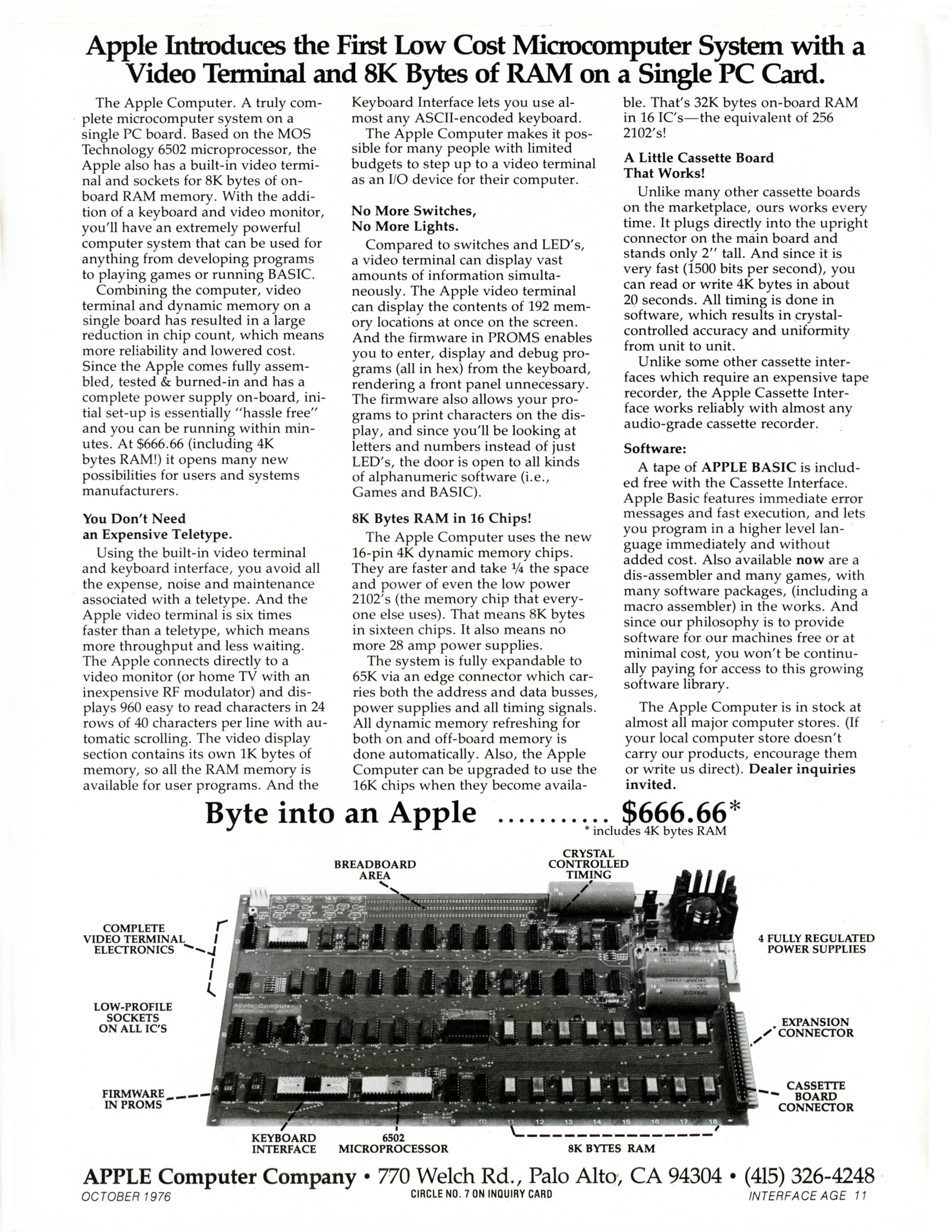
We remember Steve Jobs as the mastermind, but the Apple I is the masterpiece of the engineering genius of his business partner Steve Wozniak. When the Steves debuted it at the Homebrew Computer Club in July 1976, the relatively small number of chips and advanced features (BASIC programming! cassette tape data storage! actual video output (just scrolling text like a teletype!)) created considerable demand on the spot. We often hear that Jobs and Wozniak started Apple in their garage, and it was there (and in their living room) that the first Apple I board was assembled. In the end, 200 units were sold by the time the Apple II was introduced the following year. Apple’s first computer may seem scary to most of today’s Mac users. But consider the company’s reputation for minimalism, accessibility, and a knack for capturing consumers’ imaginations. All these qualities were present on that board 50 years ago.
Related content:
Ridley Scott talks about the making of Apple’s iconic ‘1984’ commercial, which aired on Super Bowl Sunday in 1984
in front simpsonsMatt Groening, Illustrated Student Guide for Apple Computers (1989)
Edgy 1990s Commercials for Apple’s Macintosh Computers by Hunter S. Thompson: Meditations on Power
Discovery: The world’s oldest extant computer user manual
Based in Seoul, Colin Mbemust write and broadcastIt’s about cities, languages and cultures. he is the author of the newsletter books about cities books as well Home page (I won’t summarize Korea) and korean newtro. Follow him on the social network formerly known as Twitter. @Colinbemust.
Source: Open Culture – www.openculture.com


