



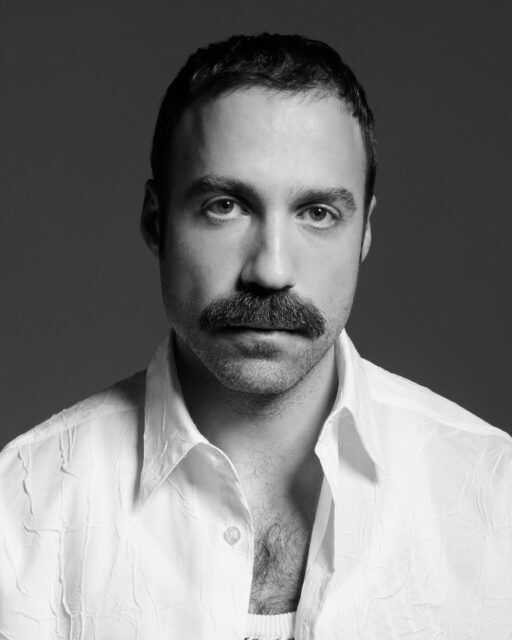
Queer menswear designer Louis Gabriel Nouci (LGN) is no stranger to pushing the boundaries of fashion. Known for dressing stars like Pedro Pascal and Alexander Skarsgård, LGN has built a brand rooted in intimacy, desire, and cinematic tension.
Now, he’s bringing that vision to OnlyFans.
In a new partnership that includes joining the platform as a creator and developing a capsule collection exclusively for the merchandise store, LGN is positioning the subscription-based platform as an unexpected extension of its own creative world.
“What interested me was freedom,” he told me in an exclusive Q&A. “Traditional social media platforms often impose invisible boundaries around the body, sexuality, and intimacy. Those themes have always been present in my work. OnlyFans has provided a space where those conversations can exist without being constantly filtered, censored, or misconstrued.”
For LGN, this movement is not an axis. It’s continuity.
“It felt close to the emotional realm that I explore through fashion,” he added.
Queer safety and creative control
A recurring theme throughout LGN’s discussion is the idea of safety, not in the physical sense, but in the creative and expression of identity.
When I asked him why OnlyFans is safer for queer users, he pointed to fundamental differences between the platforms in how they approach visibility.
“Many queer people have spent their lives navigating spaces where their desires, bodies, and identities are deemed inappropriate,” he says. “OnlyFans starts with a different premise: people are allowed to be who they are.”
This shift, he explained, creates a sense of agency that mainstream platforms often lack.
“For me, it means being able to explore themes like desire, vulnerability, masculinity and intimacy without diluting them for a wider audience.”
LGN’s work has always leant toward that emotional spectrum, but OnlyFans gives him a more direct channel to express it. He describes the content there as a “raw, intimate extension of the LGN universe,” where viewers have access to processes, images and ideas that feel less mediated.
Eroticism as a design language
Fashion and eroticism have long been shared areas, but LGN isn’t convinced the industry is becoming more open about it.
“I don’t know if it’s getting easier or not. If anything, it feels like the opposite,” he says. “Fashion has always been driven by desire, fantasy and glamour, but we now live in an era where bodies and sexuality are often treated with more sensitivity than they were 20 or 30 years ago.”
He pointed to historical fashion imagery and editorial work as evidence of a freer visual language that would be difficult to recreate today.
“When I look at the work of photographers like Helmut Newton, Herb Ritts, and Bruce Weber, and even many fashion campaigns from the 1990s, I get the sense that there was a degree of freedom that is hard to find today.”
For LGN, eroticism is not about provocation, but about its structure.
“Clothing is about charm, confidence, fantasy, vulnerability and how you present yourself to others,” he said. “Eroticism is not separate from fashion; it is one of the foundations of fashion.”
Pedro Pascal to Lestat
When discussing who best embodies LGN’s aesthetic, LGN has shifted from fame to emphasis on presence.
He highlighted Pedro Pascal, noting that the actor reflects a modern approach to masculinity: open, aware of emotions, and non-coercive.
“People like Pedro Pascal embody the modern masculinity that resonates with my work: confident, sensitive, intelligent, and comfortable with vulnerability.”
But his cultural references go beyond Hollywood.
When asked which fictional queer icon he would wear, LGN answered without hesitation: Lestat de Lioncoat.
“He is theatrical, seductive, dangerous, romantic and impossible to categorize,” LGN said. “There’s something very modern about that kind of fluidity.”
This is the perfect answer for designers who have always resisted categorizing their work.
fashion without filters
Throughout our conversation, LGN returned to one central idea: creative freedom over categorization.
When asked about representation in fashion, he said, “I don’t want queer identity to become another marketing category.” “I would rather people be given the space to develop strong, personal opinions and genuine perspectives.”
For him, the future of fashion is not about labels. It’s about permissions. It’s about being explicit, emotional, and unedited.
In that sense, OnlyFans is not a detour for LGN. It’s just another runway. View his OnlyFans page here.
Source: Gayety – gayety.com


