



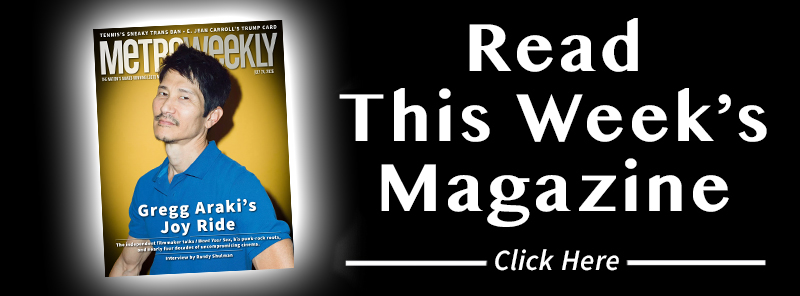
“I want people to enjoy themselves,” says Gregg Araki of his newest blast of a film, I Want Your Sex, in which a starkly gorgeous Olivia Wilde plays a super-trendy abstract artist — she makes vaginas out of chewed pink bubble gum — who takes her latest employee, a doe-eyed innocent played by Cooper Hoffman, on a carnal thrill ride that blurs the line between sexual harassment and sensual awakening.
“I remember when we first started screening the film when I was still working on the edit,” says Araki, 66, “and people were surprised by how friendly it was. The sensibility behind I Want Your Sex is fun and pop. I want to bring a little bit of joy into the world.”
Joy surfaces multiple times during our hour-long Zoom conversation. Coming off a string of press interviews for I Want Your Sex, which opens in theaters nationwide on July 31, Araki seems happy and relaxed. He’s all smiles and stories.
I’ve long considered Araki’s Mysterious Skin a masterpiece of independent queer cinema. Starring Joseph Gordon-Levitt and Brady Corbett — who went on to direct The Brutalist — and based on the novel by Scott Heim, the 2004 drama approaches queer trauma with a searing, surreal power few films can match. It remains essential viewing.
But so are all of Araki’s films, born of confidence, fearlessness, and verve. He exploded onto the scene in 1992 with the queer HIV-outlaw indie The Living End and followed it with his now-heralded “Teen Apocalypse Trilogy” — Totally F***ed Up (1993), The Doom Generation (1995), and Nowhere (1997). The films are explicit and violent, with dialogue so heightened that the characters practically speak a language of their own. They are cinema at its most brash and unafraid, their jagged-edged editing and eye-popping, intoxicating design drawing direct thematic and stylistic lines to the sleeker, coyly playful I Want Your Sex.
Araki, who has been making movies for nearly four decades, has never drifted from his distinctive style or sensibility. Someone once told me he’s an acquired taste. Perhaps — but that can be said of any filmmaker with a truly singular voice, and Araki is a taste worth acquiring, particularly for LGBTQ viewers of every generation.
“My background has always been as somebody who is punk rock, new wave,” he says. “I’m of color, I’m queer, I’m all of it. And I actually don’t view that as a disadvantage — I view it as a superpower. The fact that I am outside of the gates, I feel like it makes me and my work — for me personally — more interesting. I’m not the white, straight, cis, middle-of-the-road super capitalist. I’m not part of that system, and that’s not what my voice is.
“And I don’t have any regrets about it. I just feel such incredible gratitude for the films I’ve been able to make,” he continues. “I don’t hold any grudges, like, ‘Oh, well, but Hollywood should have given me this movie to make because that’s what I really want to do.’ I really want to do exactly what I’ve done and what I’m doing, and that’s all that matters to me.”
METRO WEEKLY: It’s so nice to meet you! I’ve wanted you on the cover of Metro Weekly for thirty years, and it just never worked out. So this time I said, “We’re going to make this happen.”
GREGG ARAKI: Goddammit, it has to happen!
MW: I’m going to start where I normally begin with a first-timer for Metro Weekly.
ARAKI: Okay.
MW: Tell us about your childhood, your upbringing.
ARAKI: I was born in Los Angeles, raised in Santa Barbara. I lived in Santa Barbara all my life until I graduated from college at U.C. Santa Barbara. I came to USC Film School in the early-to-mid-eighties to do a master’s in film production. My childhood was very super suburban, super middle-class. My parents were high school-educated — they didn’t go to college, they were working class. My dad did maintenance at a nursery where they grew orchids. He worked on the machines. And my mom was a bookkeeper. So I just had the most idyllic suburban childhood there.
And it’s funny, I have a brother and a sister, but I’ve always been the artistic black sheep of the family. My brother and sister, they have regular jobs, and they married. My brother got divorced, but he had kids, and they just have heteronormative lives. I’ve always been the sort of outlier.
When I was doing my undergraduate studies and my undergraduate film studies at U.C. Santa Barbara, that was when punk rock music, new wave music, and alternative culture were exploding. I was literally 20 years old — basically the age of Cooper’s character in I Want Your Sex — just being this kind of wannabe, confused, uncertain artist looking for my place in the world. I went to so many shows. I had a funny haircut. I wore a leather jacket. That moment had such a profound effect on my sensibility. It just formed me, literally.
So when I went to film school — I wanted to be a director, all of this stuff — that was my primary influence: the idea of the way that kind of punk rock music movement was of “DIY, follow your own drummer, do your own thing, don’t worry about the mainstream, don’t worry about Top 40” music. It’s kind of self-expression, and that was just as I was a baby, coming out of the womb as an artist. I’ve always been that kid.
And then on top of that, grappling with my queerness, my sexuality when I was 19, 20, sneaking out to a gay bar for the first time –- which is why that theme of sex, sexuality, and being on a journey of discovery and experience and having those confusing sexual experiences as a young person, is such an important theme in I Want Your Sex –- all of that was happening at the same time. As a young person, I was just figuring myself out and being formed, coming of age.
I’m Japanese American, but both my parents were in the relocation camps in the ’40s. They got married in the ’50s, and were very much entrenched in that dynamic of the American, conservative, Leave It to Beaver nuclear family-type world. But my parents, unlike a lot of my contemporaries — and I just thought about this recently — were always super accepting of me. I always had their unconditional love. I always knew I had their support when I came out as queer. There was never any sort of pushback, never any tears, never any like, “Oh no, what’s going to happen?” And it only dawned on me recently that because of the generation my parents are, they could absolutely have gone the other way.
And so I’ve always felt very fortunate for my upbringing because I always knew that I had the love and support of my parents. And it really is what enabled me to be free to explore becoming an artist, being a queer person, going out into the world and making my mark and doing my thing.
MW: You were coming out at the time of the height of AIDS. A lot of parents — my own included — were terrified for their gay children. So what do you think was different about your parents?
ARAKI: I feel like they were just very special. I remember literally — it’s funny you talk about AIDS because when I made The Living End in 1992, it was playing in a big theater here in Los Angeles. I remember my parents wanted to see The Living End. I’m all, “I just don’t think you should see it. I love you guys and I appreciate how much you support me, but I don’t make my movies for you.” I can’t write a movie thinking about whether my mother is going to be watching it, so I have to censor all the more transgressive parts of the script. So I remember specifically saying, “Please don’t see the movie. It’s not for you.”
And they snuck in and saw it anyway without my approval. Even the theater manager was like, “Ma’am, I don’t know if this movie’s for you,” or whatever. And she’s like, “No, no, we want to see it.” The audience was literally a bunch of gay guys and younger people. And so they saw the movie and my mom said, “Oh, it was really good.” But she was very worried — because it’s about two HIV positive characters — that I was HIV-positive, and I’m not.
So I could tell her, “Don’t worry.” It was me talking about HIV and talking about that huge anxiety that my whole generation was consumed with in the early ’90s, but that I was not HIV positive. And she was like, “Okay, thank goodness.” But she still had to watch a guy getting choked in the shower and being jerked off and people getting fucked on a beach with a gun in their mouth. All the stuff that’s in The Living End that you don’t want your mom to see.
MW: May I ask, and I don’t mean to sound insensitive, are your parents still with us?
ARAKI: My dad passed away last year. I think it was last year or the year before. He was 98, though, and my mom is 94 and going strong. So again, I’m just one of those people in life who is just so lucky. I’ve been very lucky all of my life. I remember when I was younger, I felt like I was so unlucky and I was cursed. But as an older person, looking back on my life, I’ve had the craziest, charmed life. And the idea that I lucked into having these parents that were so supportive, so understanding, and that I was born when I was born, that I was an undergraduate when punk rock, new wave music came out. I was right in the middle of ’90s Sundance. I was making indie movies right as the indie movie scene was exploding. I’ve always managed to be in the right place at the right time.
MW: I remember when The Living End came out. It was like being shot out of a cannon. Before this interview, I did some research. I’ve seen Mysterious Skin several times — it’s one of my all-time favorites. But it dawned on me I had never seen Totally F***ed Up, The Doom Generation, or Nowhere, your “Teen Apocalypse Trilogy” from the 1990s.
ARAKI: Oh, the three…
MW: So I watched them last weekend on the Criterion Channel, because thank god for Criterion.
ARAKI: [Laughs.] Thank god for Criterion.
MW: And really, I can’t sing their praises enough. I was blown away by the trajectory of the films. Everyone’s talking about The Odyssey, an epic poem, and all I could think of while watching these movies was “This is Gregg Araki’s epic poem. This is his Homer moment.” It was like watching poetry unfold on the screen. I was just gobsmacked.
ARAKI: Thank you so much. That really means a lot to me.
MW: One of the things that I really loved about Totally F***ed Up, was the artfulness of the editing. And I loved that moment where you had a cue card that read, “Narrative starts here.”
ARAKI: Totally F***ed Up is very influenced by Masculin Féminin, the [Jean-Luc] Godard film. Godard was a big, big influence on me in film school, and that was my homage to Godard. He was very playful with these non-diegetic moments. Of all my movies, Totally F***ed Up is the most overtly Godardian.
I mean, those movies, I can’t believe — because we just restored Doom and Nowhere a few years ago — and when those movies came out, they barely came out. I mean, they were distributed, but in a very sporadic and limited way. And the fact that they’ve lived on all these years and people love them and talk about them all the time is incredible. I can’t believe it.
MW: One thing I did enjoy, especially in Totally F***ed Up, was when we see the Excalibur sign, or we see Tower Records — we couldn’t have known at the time Tower Records would be long gone.
ARAKI: Yeah.
MW: And so your love of Los Angeles captures these bits of history that some of us can revisit. Just like the characters using real phones.
ARAKI: [Laughs.] Yeah, landlines. Even in those early movies like Totally F***ed Up, Living End, and the two black-and-white movies that were before that, I had no production designer, no [director of photography]. I did everything myself. And even from those early stages, I was very interested in this kind of surreal, strange landscape. I was always interested in not just reality, but a sort of elevated reality where everything was heightened, felt strange, surreal, alien.
MW: I also love the way the early films start from a place of bliss and descend into bleakness, horror, and trauma. It’s an interesting journey that you take us through. That doesn’t happen with I Want Your Sex, at least not as overtly.
ARAKI: For the new movie, I was very intentionally wanting to do something more pop, more fun. Not necessarily more commercial or anything, but the idea being that I wanted to make a movie that was full of queer joy. As an audience member, I personally — because the world right now and America, in particular, is so nightmarish and so awful and terrible beyond imagination — don’t want to watch something that’s too dark or too dystopian.
So it was very intentional with I Want Your Sex, even though there are darker elements of it — I wanted it to be a fun ride, full of queer joy where audiences could have a fun time at the movies, but still have it be provocative, have it be challenging, all the things my movies always are.
MW: I saw I Want Your Sex last night and honestly can’t wait to see it again. I had so much fun watching the performances that you got out of Olivia Wilde and Cooper Hoffman. It’s such a funny movie and, you’re right, you leave the theater feeling an overwhelming sense of joy.
ARAKI: I feel like joy is hard to come by right now. The theme of the movie, which has to do with sexual repression and sexual liberation, is the idea of people freeing themselves. Because I absolutely feel like that old cliché of “Make love, not war.” I feel like so much of that hatred and that violence and the misogyny and the misery of the world right now is tied to oppression. It’s tied to people being just so pent-up and miserable that if people could be more free, more open, and not so uptight, I just think the world would be a much better place, and maybe we would have less fucking war and fucking violence and ugliness in the world.
MW: How do you get your actors on board with a scene like Cooper wearing a piggy mask and having to act like he’s had a dildo shoved up his ass for the first time? How do you get the actors to, say, give themselves over to you as a director?
ARAKI: With my projects, it’s all in the script. It’s not like I surprise people and go, “Guess what’s going to happen on set today!?” So it’s like people that are not willing to go there just don’t audition, or they pass, or they don’t come in.
For Olivia, this was like a kind of dream role because I think she got tired of playing the beautiful wife, the beautiful girlfriend, the beautiful minister, all the parts that Hollywood was offering to her. So she wanted to stretch her wings and do something juicy, creative, and just really out there. And so she was fearless and just dove right in the pool and went for it.
For Cooper, he told me, “This script terrified me. This script was so scary to me.” But he’s all, “That’s why I wanted to do it.” And that is an indication that Cooper’s going to be one of those actors that’s around forever. He’s going to have an amazing career because he’s making those choices of challenging himself, of really going to those places that as an actor scare him.
I mean, he’d never done nudity, he’d never done a sex scene, he’d never done anything like this part before, and that’s why he wanted to do it — that was the attraction. So he was scared, but at the same time he was really excited to go there, and I think that’s the true mark of an actor who’s a real artist.
MW: He was a great casting choice.
ARAKI: Olivia was attached first — that’s how the movie got made, and then we were casting the Elliot role, and Olivia brought up Cooper. I said, “Oh, hold on. We’re talking about Cooper Hoffman, the kid from fucking Licorice Pizza? That’s so weird and creepy. I don’t want to see your character fucking that guy.”
Cooper did a self-tape, and he was very good. He flew himself out here to do a chemistry read in person with Olivia. And once I saw that, it was clear they had amazing chemistry — the dynamic between them was so alive. And Cooper, in person, I mean, he was a baby when we made this movie, I think he just turned 21, but in person, he had so much gravitas, and he is such an amazing actor and so talented that as soon as I saw it in the room, I was like, “My job is done. I just literally have to turn the camera on and make sure I don’t fuck it up.”
MW: I loved his father, the late Philip Seymour Hoffman, and whenever you see Cooper onscreen, you see the talent of his father within him.
ARAKI: For sure.
MW: It’s passed down.
ARAKI: Yeah, he’s definitely a generational talent. I think his father’s the same way — always took the craziest, most challenging roles — that’s why he’s so beloved and remembered. He was in fucking Happiness and The Master, all the fucking shit that he did in his too-brief career. That’s what true actors do — they really pursue these great, sometimes very uncomfortable roles.
MW: I loved the other casting choices as well, especially Mason Gooding, Chase Sui Wonders, and Charli XCX.
ARAKI: We were so lucky to get the cast that we got. I couldn’t believe it when they all signed on. And they’re all so good and they’re all so fun to watch. It was just a really super special ensemble.
One of the things I loved about the movie is everybody’s so different. They have different styles and different energies. I mean, the way Cooper is when he is with Mason versus the way Cooper is when he’s with Olivia, the way he’s with Chase, the dynamic is always shifting. When he’s with Roxane Mesquida, who is in my TV show Now Apocalypse and Kaboom, is totally different. It’s just so fun to watch Cooper interact with all these different combinations.

MW: Sex is a vital component in all of your films. Why is that?
ARAKI: I relate very strongly to the Erika Tracy [Olivia Wilde] character in the sense that a lot of things she says about sex and art and all of that is very much straight out of my mouth into her mouth. I mean, the things she says in that first interview about sex, and about how people you’ve slept with know you in a way that nobody else knows you — that that is what I’m interested in as an artist, those moments of truth. She became very much kind of a mouthpiece for me, although of course I don’t cross the moral boundaries that she crosses, but a lot of her feelings about creativity, art, sex — all that are very much autobiographical.
MW: There’s a direct line from your early films to I Want Your Sex, because they are so, for lack of a better word, explicit. You watch them and think, “Could this even get made today?”
ARAKI: Well, I Want Your Sex barely got made. It took 12 years, so…
MW: Really?
ARAKI: Yeah, I have been working on the movie for 12 years, I think. I first read the spec script for it, which was very, very different in 2012 or 2013. So I’ve been working on this movie for a long fucking time. The original script was a female sub and a male dom, and it was more like Fifty Shades of Grey. And that was 2015, 2016, it was kind of going to happen and then fell apart.
And then after #MeToo, I changed the sex roles around because I didn’t really want to have a woman getting dragged around by the hair. I don’t want to kink-shame anybody, but it was just not an image I felt comfortable with putting out into the world, particularly as the patriarchies really come roaring back and people are like, “Patriarchy, yay.”
So I switched it, made it a male sub, female dom, and that was the birth of Erika Tracy. And that character became, as a female, I think, so much more interesting. And so a lot of things changed in the script in the interim. So, yeah, it’s been a long time in the making.
MW: But back to my question, do you think your earlier films could get made today?
ARAKI: Well, the reason for, honestly, the longevity of my career is that I’ve always made my movies in a very indie, low-budget way. I’ve never made the $20 million quasi-studio movie. I’ve never had a big, huge budget. Even The Doom Generation cost $750,000 back in 1994 or whatever. But my movies have always made their money back for the company that made them because they are not a huge risk. They’re not a huge investment.
I feel like that’s the reason why I’ve been allowed to make movies, because when you make that big movie that doesn’t make its money back — when people lose $10 million, $15 million on your movie — that makes it very hard to make the next movie. But I’ve always managed to do the movies on a budget. Mysterious Skin was a little over a million, but I knew we’d have to make it for that price to make the movie that I wanted to make — that was that uncompromising. So it’s been a trade-off for me, but again, I feel so fortunate and lucky to have made the movies I made.
MW: So I’m going to ask you a personal question: what does sex mean to you?
ARAKI: Well, it’s very much what Erika says. I mean, like I said, she speaks for me in a way when she talks about sex and how important it is, how her sexual experiences are literally what have formed her as a person — that is one hundred percent autobiographical.
Particularly as a queer person, when I think back on when I was 19, 20 years old and snuck out to a gay bar for the first time, that was such an important step for me, and my journey, to leave that room, leave the house, and go out into this world of adventure, confusion, mistakes, bad shit happening, good shit happening. You fall in love, you get your heart broken, you have a terrible boyfriend or girlfriend, you’re in a terrible relationship, you’re in an okay relationship that ends.
All of that is what Erika says in the movie. It’s like all of those mistakes, all of those traumas, hopefully none of them are too traumatic — though sometimes it feels like you’re going to die because you’re so heartbroken. All that stuff — I can’t imagine life without it. It has literally been my whole life’s journey as a person, and it’s all because of sex. It’s all because of that. It’s all learning about life and love and relationships.
And that’s why her character — and speaking for myself — reacts so strongly to this idea of a young generation that’s not experiencing that, that is literally just passing that by. The one thing about my life is that I have no regrets. None. I don’t regret, ever. I don’t live a life with regrets. I’ve done everything I want to do in my life. I’ve become an artist, become a filmmaker, taken all these risks, had these sexual experiences, and I don’t regret a single minute of it — not any of it.
And I feel like it’s so rare and so lucky and privileged to feel like that, because a lot of people live a life of regrets. And for young people that are saying, “Yeah, I don’t want to have relationships, I don’t want to date, I don’t want to do it.” Are you going to regret it? Maybe you’re not. I definitely would, but I’m a different generation.
I Want Your Sex is Rated R and now playing in theaters nationwide. Visit fandango.com.
Gregg Araki’s “Teen Apocalypse Trilogy” is currently available on the Criterion Channel. Visit criterionchannel.com.
Mysterious Skin and The Living End are available at Strand Releasing. Visit strandreleasing.com.
Source: Metro Weekly – www.metroweekly.com


