



In the 2026 midterm elections, people in at least 38 jurisdictions across the United States voted to limit or ban data centers.
Data centers have existed in the U.S. for decades, but their numbers have increased rapidly in recent years to support the development of artificial intelligence. As the number of these facilities has grown, the public has become more aware of them and backlash against them has intensified.
Pew Research Center has done several analyses about data centers in recent years. Here are some key facts from these studies.
There were more than 3,000 operational data centers in the U.S. as of February 2026, with at least 1,500 others in development. Existing data centers tend to be clustered together: 87% are in urban areas and 89% are within 5 miles of another data center.
Virginia, Texas and Georgia lead the country in planned data centers
Number of data centers in each state, by operating status

Note: Planned category includes data centers listed as “under construction,” planned or “land banked.” Only the top 15 states by total are shown.
Source: Data Center Map, accessed Feb. 19, 2026.
PEW RESEARCH CENTER
Virginia, Texas and Georgia lead the country in planned data centers
Number of data centers in each state, by operating status
| State | Total | Currently operating | Planned |
|---|---|---|---|
| Virginia | 685 | 398 | 287 |
| Texas | 466 | 296 | 170 |
| California | 331 | 277 | 54 |
| Illinois | 262 | 139 | 123 |
| Georgia | 235 | 94 | 141 |
| Ohio | 223 | 166 | 57 |
| Arizona | 184 | 98 | 86 |
| New York | 154 | 148 | 6 |
| Oregon | 142 | 115 | 27 |
| Washington | 135 | 124 | 11 |
| Pennsylvania | 129 | 78 | 51 |
| Florida | 128 | 120 | 8 |
| North Carolina | 113 | 72 | 41 |
| Iowa | 105 | 64 | 41 |
| Indiana | 92 | 38 | 54 |
Note: Planned category includes data centers listed as “under construction,” planned or “land banked.” Only the top 15 states by total are shown.
Source: Data Center Map, accessed Feb. 19, 2026.
PEW RESEARCH CENTER
However, data centers are increasingly coming to new areas of the country. Two-thirds of all planned data centers are in rural areas, and 39% are in counties that don’t currently have one.
As of February, nine states had 100 or more operational data centers. Virginia had the most at 398, followed by Texas (296) and California (277). Virginia also had 287 planned data centers – far more than any other state. Loudoun County in Northern Virginia is known as “Data Center Alley” because of its high density of data centers.
Around four-in-ten U.S. adults (42%) lived within 5 miles of an existing or planned data center as of February. This included 38% who lived within 5 miles of an operational data center and 4% who lived within that distance of a planned one.
Americans have become more pessimistic about data centers’ impact on a range of things, according to a summer 2026 survey.
Americans have become more likely to say data centers have a negative impact in various areas
% of U.S. adults who say data centers are mostly bad for …

Note: Respondents who did not answer are not shown.
Source: Survey of U.S. adults conducted July 20-Aug. 9, 2026.
PEW RESEARCH CENTER
Americans have become more likely to say data centers have a negative impact in various areas
% of U.S. adults who say data centers are mostly bad for …
| Topic | Jan ’26 | Aug ’26 |
|---|---|---|
| The environment | 39 | 54 |
| Home energy costs | 38 | 50 |
| People’s quality of life nearby | 30 | 49 |
| Local jobs | 15 | 24 |
| Local tax revenue | 12 | 21 |
Note: Respondents who did not answer are not shown.
Source: Survey of U.S. adults conducted July 20-Aug. 9, 2026.
PEW RESEARCH CENTER
We asked U.S. adults whether they think data centers are mostly good, mostly bad, or neither good nor bad for:
- The environment
- Home energy costs
- People’s quality of life nearby
- Local jobs
- Local tax revenue
About half or more said data centers are mostly bad for the environment, home energy costs and neighbors’ quality of life – up substantially since January.
Americans’ views of the impact of data centers on local jobs and local tax revenue were more mixed. Similar shares – between 21% and 24% – said that data centers are mostly good and mostly bad for these things. Still, the public became more likely between January and August to say data centers are mostly bad for each of these things.
As of the summer survey, Americans who lived near a data center and those who didn’t live near one had similar views of the facilities and their impacts.
Six-in-ten U.S. adults said this past summer that they would be not too or not at all comfortable with a new data center operating in their area. Just 7% said they’d be extremely or very comfortable with this, and 19% said they’d be somewhat comfortable.
Even though data centers are currently concentrated in urban areas, the public’s discomfort with them cuts across community types. Majorities of urban, suburban and rural Americans said they would not be comfortable with a new data center in their area.
6 in 10 Americans would be not too or not at all comfortable with a new local data center
% who say they would be __ comfortable with a new data center operating in their area

Note: Respondents who did not answer are not shown.
Source: Survey of U.S. adults conducted July 20-Aug. 9, 2026
PEW RESEARCH CENTER
6 in 10 Americans would be not too or not at all comfortable with a new local data center
% who say they would be __ comfortable with a new data center operating in their area
| Extremely/ Very | Somewhat | Not too/Not at all | Have not heard of data centers | Grouping | |
|---|---|---|---|---|---|
| Total | 7 | 19 | 60 | 12 | total |
| Urban | 7 | 20 | 57 | 14 | urban |
| Suburban | 7 | 20 | 63 | 9 | urban |
| Rural | 6 | 18 | 60 | 14 | urban |
| Rep/Lean Rep | 10 | 24 | 54 | 11 | party |
| Conservative | 12 | 25 | 54 | 9 | party |
| Mod/Lib | 7 | 22 | 55 | 15 | party |
| Dem/Lean Dem | 4 | 16 | 68 | 10 | party |
| Cons/Mod | 6 | 22 | 58 | 14 | party |
| Liberal | 3 | 10 | 81 | 5 | party |
| Heard a lot | 11 | 16 | 73 | heard | |
| Heard a little | 6 | 26 | 66 | heard |
Note: Respondents who did not answer are not shown.
Source: Survey of U.S. adults conducted July 20-Aug. 9, 2026
PEW RESEARCH CENTER
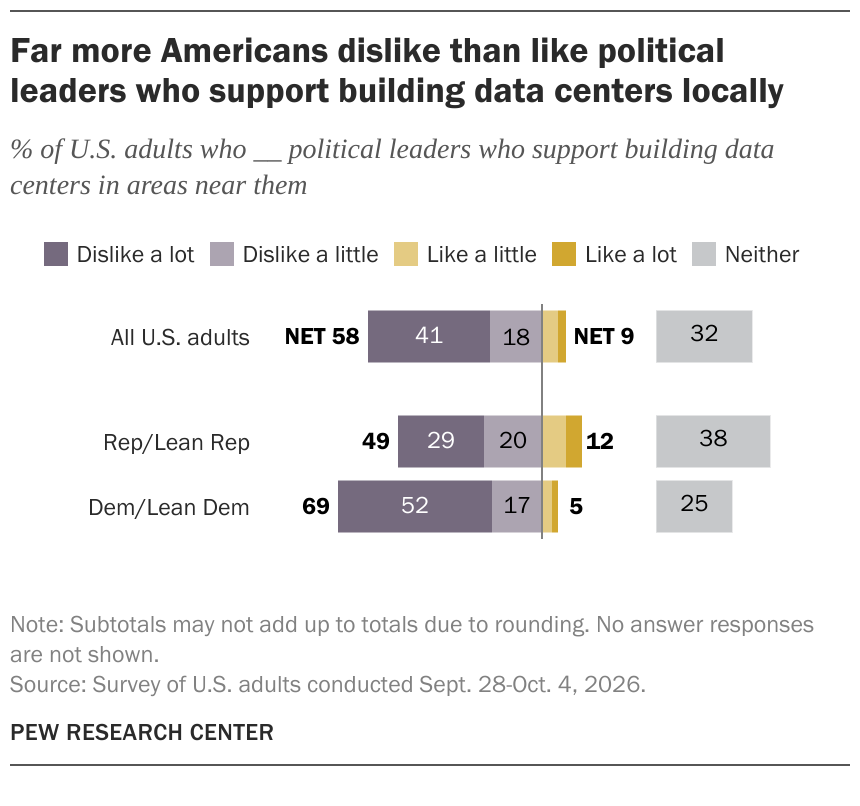
More Americans said in a fall 2026 survey that they dislike than like political leaders who support building data centers locally. About six-in-ten U.S. adults (58%) said they dislike these leaders, compared with 9% who said they like them. Another 32% said they neither like nor dislike such leaders.
Far more Americans dislike than like political leaders who support building data centers locally
% of U.S. adults who __ political leaders who support building data centers in areas near them
Note: Subtotals may not add up to totals due to rounding. No answer responses are not shown.
Source: Survey of U.S. adults conducted Sept. 28-Oct. 4, 2026.
PEW RESEARCH CENTER
Far more Americans dislike than like political leaders who support building data centers locally
% of U.S. adults who __ political leaders who support building data centers in areas near them
| Group | NET Dislike | Dislike a lot | Dislike a little | Neither like nor dislike | Like a little | Like a lot | NET Like | group |
|---|---|---|---|---|---|---|---|---|
| All U.S. adults | 58% | 41% | 18% | 32% | 5% | 3% | 9% | all |
| Rep/Lean Rep | 49% | 29% | 20% | 38% | 8% | 5% | 12% | sub |
| Dem/Lean Dem | 69% | 52% | 17% | 25% | 3% | 2% | 5% | sub |
Note: Subtotals may not add up to totals due to rounding. No answer responses are not shown.
Source: Survey of U.S. adults conducted Sept. 28-Oct. 4, 2026.
PEW RESEARCH CENTER
Related: On Facebook and Instagram, Political Ads Are Increasingly Critical of Data Centers
Some Americans blame data centers for their rising home energy costs, according to a March survey.
Most Americans said their home energy costs had gone up in the last few years. Among those who said this, about two-thirds pointed to data centers using more energy as a major or minor reason why. Another 26% said they weren’t sure whether data centers were a reason for this, and 9% ruled out data centers as a contributing factor.
Americans were most likely to blame their rising energy costs on utility companies wanting to make more money. More than eight-in-ten (85%) of those who said their energy costs had increased said this was a major or minor reason why. Still, data centers were a more common source of blame than government regulations or Americans’ own increased energy use.
Across our surveys, Democrats and Republicans alike tend to have more negative than positive views of data centers. (In this analysis, Democrats and Republicans include those who lean to each party.)
For example, both Democrats and Republicans were more likely as of August to have negative than positive views of data centers’ impact on the environment, home energy costs and people’s quality of life nearby. (However, they differed on whether data centers are mostly good or mostly bad for local jobs and local tax revenue.)
In the same survey, 68% of Democrats and 54% of Republicans said they would be not too or not at all comfortable with a new data center in their area. Just 4% of Democrats and 10% of Republicans said they’d be extremely or very comfortable with this.
In our fall survey, Democrats were more likely than Republicans to disapprove of leaders who support data centers (69% vs. 49%). Still, people in both parties were much more likely to say they dislike than like such leaders, though sizable shares also said they neither like nor dislike them.
In addition, similar shares in both parties pointed to data centers as a major reason for their rising home energy costs in our March survey. Democrats and Republicans differed on some other potential reasons, including government regulations and extreme weather events.
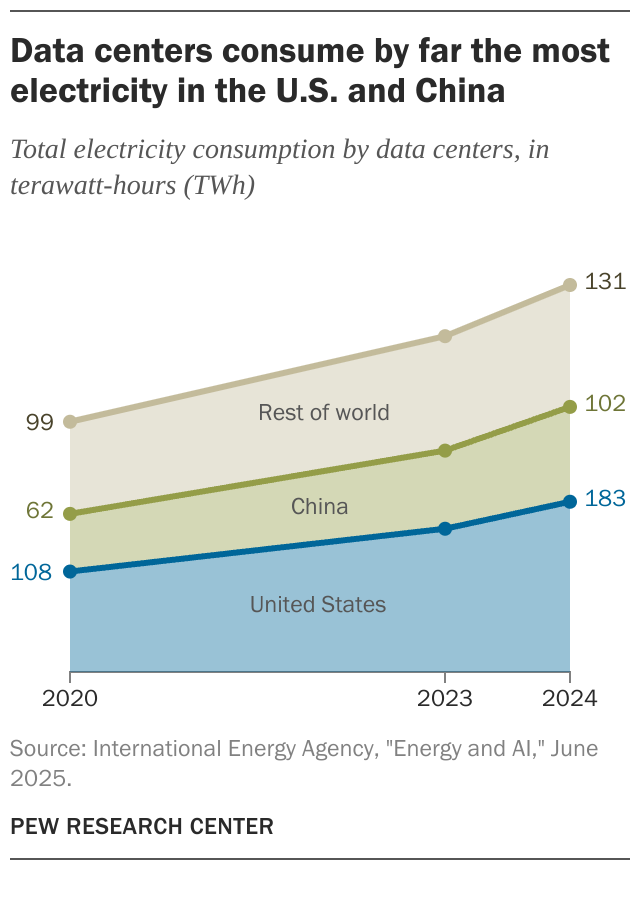
The amount of electricity that U.S. data centers used increased significantly from 2020 to 2024, according to an October 2025 analysis of data from the International Energy Agency. In 2020, U.S. data centers used 108 terawatt-hours (TWh) of electricity in total, and that increased to 183 TWh in 2024. Their electricity use is projected to grow to 426 TWh in 2030.
Data centers consume by far the most electricity in the U.S. and China
Total electricity consumption by data centers, in terawatt-hours (TWh)
Source: International Energy Agency, “Energy and AI,” June 2025.
PEW RESEARCH CENTER
Data centers consume by far the most electricity in the U.S. and China
Total electricity consumption by data centers, in terawatt-hours (TWh)
| World | United States | China | Rest of world | |
|---|---|---|---|---|
| 2020 | 269 | 108 | 62 | 99 |
| 2023 | 361 | 154 | 84 | 123 |
| 2024 | 416 | 183 | 102 | 131 |
Source: International Energy Agency, “Energy and AI,” June 2025.
PEW RESEARCH CENTER
In 2024, the U.S. used more electricity for data centers than the entire Asia Pacific region (150 TWh) or Europe (68 TWh). In fact, the U.S. and China (102 TWh) together used 69% of all electricity worldwide that went to data centers in 2024.
In the U.S., the electricity that went to data centers accounted for more than 4% of the country’s total electricity consumption in 2024. But in some states with lots of data centers, that share was much higher. In 2023 – the most recent year with state-level figures available – data centers used about 26% of the total electricity supply in Virginia and 15% in North Dakota, 12% in Nebraska and 11% in both Iowa and Oregon.
Source: Pew Research Center – www.pewresearch.org