



The Supreme Court today heard two cases that could change how the Equal Protection Clause and Title IX are enforced.
The Little v. Hecox and West Virginia v. BPJ cases ask courts to determine whether state laws that prohibit transgender girls from participating on girls’ teams in publicly funded schools violate the Equal Protection Clause of the Fourteenth Amendment and Title IX. The ruling could change the interpretation of laws addressing sex discrimination nationwide.
Chief Justice John Roberts questioned whether Bostock v. Clayton County, a landmark case in which Title VII of the Civil Rights Act of 1964 protects employees from discrimination based on sexual orientation or gender identity, applied to athletics. He noted that transgender girls are assigned male at birth and questioned whether they should be considered girls under the law.
“I think the basic focus of the discussion so far, in my view, is whether your position should be seen as a challenge to the gender-based distinction between boys and girls, or whether you are completely convinced by the distinction between boys and girls, and that you simply want an exception to the biological definition of a girl.”
“How do we approach the situation, not in terms of men versus women, but whether there should be an exception in terms of the definition of women,” Roberts added, suggesting the implications could extend beyond athletics. “If we were to adopt it, it would apply across the board, not just in the field of athletics.”
Justice Clarence Thomas echoed Roberts’ concerns, questioning how gender-based classifications work under Title IX and what would happen if Idaho’s ban is rescinded.
“Is there any validity to the classification of men and women sports as in Title IX? Let’s say there’s a man who isn’t athletic enough, and he’s a bad tennis player, for example, and doesn’t make the women’s team. He wants to join the women’s tennis team, and he says there’s no way I can be better than the women’s tennis players. How is that different from what you’re being asked to do here?”
Justice Samuel Alito said something many on the court seemed reluctant to say directly: the legal definition of sex.
“What does the term ‘sex’ mean in Title IX?” Alito asked Hashim Muppan, the principal deputy attorney general who had argued for upholding the Idaho law. Muppan argued that gender should be defined at birth.
“We think this law is properly interpreted according to the normal, traditional definition of biological sex, and that reproductive biology is probably the best way to understand it, given the time it was enacted,” Moupan said.
Justice Sonia Sotomayor pushed back, questioning why that definition did not amount to sex discrimination against Lindsey Hecox under Idaho law. Sotomayor argued that even though Ms. Hecox’s gender is legally defined as male, her exclusion still creates discrimination.
“This remains an exception,” Sotomayor said. “It is a subclass of people who are covered by the law, and others who are not covered by the law.”
Justice Elena Kagan highlighted the far-reaching implications of the case, asking whether the ruling for each state would impose a single definition of sex on 23 states that currently have different laws and standards. Both parties acknowledged that scientific research does not yet provide clear consent regarding sex.
“I think what we absolutely want to have is a complete investigation, so we were really pushing for a complete record before a final determination of the scientific uncertainties was made,” said Kathleen Harnett, Hecox’s legal representative. “Maybe later records will have different results, but I don’t think so.”
“When there’s scientific uncertainty, try a little bit,” Kagan responded.
Justice Brett Kavanaugh focused on the impact of such policies on cisgender girls, arguing that allowing transgender girls to compete could undermine Title IX’s original purpose.
“It’s hurtful for the individual female athletes who weren’t able to be on the team, who weren’t able to be in the stands for a medal, who weren’t able to participate in a full league,” Kavanaugh said. “I don’t think you can ignore that.”
Justice Amy Coney Barrett questioned whether the Idaho law discriminates on the basis of transgender status or gender.
“Transgender boys can play on men’s teams, so how can you say this is discrimination based on transgender status when in reality it only affects transgender girls, not transgender boys?”
Harnett responded, “I think it’s related to the animus point, which is that it’s not completely excluding transgender people, for example. Transgender women were being excluded.”
Justice Ketanji Brown Jackson took issue with the idea that explicitly excluding transgender people is not discrimination.
“I find it hard to understand how this law can say that it doesn’t discriminate based on transgender status. This law is explicitly designed to prevent transgender women from playing on women’s sports teams… This law treats transgender women differently than cis women, right?”
Idaho Attorney General Alan Hurst sued the court to uphold the state’s ban, arguing that allowing participation based on gender identity, with or without medical intervention, deprives girls of opportunities protected under federal law.
Hirst emphasized that biological “sex,” not gender identity, is important in sports, citing scientific evidence that people assigned male at birth tend to have an athletic advantage.
BPJ representative Joshua Block was asked whether the ruling in BPJ’s favor redefines sex under federal law.
“I don’t think the purpose of Title IX is to precisely define sex,” Block said. “I think the goal is to make sure that sex is not used to deny opportunity.”
Becky Pepper Jackson, 15, the alleged plaintiff BPJ, also spoke out.
“I play in school for the same reasons as the other kids on the track team: to make friends, have fun, and challenge myself through practice and teamwork,” Pepper Jackson said. “And all I wanted was the same opportunities as my peers. But in 2021, politicians in my state passed a law that prohibits me, the only transgender student-athlete in the state, from playing as my true self. This is unfair to me and all transgender kids who want the freedom to just be themselves.”
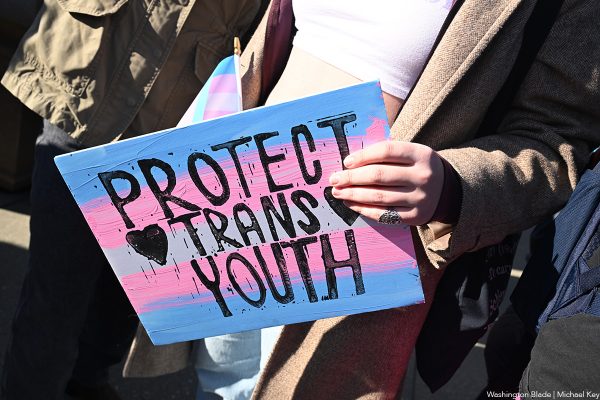
Outside court, advocates echoed those concerns as the justices deliberated.
“Becky just wants to be with her teammates on the track team and experience the camaraderie and many documented benefits of participating in a team sport,” said Sasha Buchert, an attorney and director of the Nonbinary and Transgender Rights Project at Lambda Legal. “While it is well-documented that participating in team sports teaches youth a myriad of skills, including leadership, teamwork, self-confidence, and health, denying students the ability to participate is not only discriminatory, but harmful to their self-esteem and sends the message that they are inadequate and deserving of exclusion. This is the argument we made today, and we hope it resonates with the Supreme Court justices.”
“This case is about whether transgender youth like Becky can participate in their schools and communities,” said Joshua Block, senior counsel for the ACLU’s LGBTQ & HIV Project. “While school athletics are fundamentally educational programs, West Virginia law completely excluded Becky from the entire school athletic program, even when there was no connection to equity or safety concerns. As the lower court found, Becky was given the option of giving up the sport or playing on a boys’ team.” Forcing her to do so is completely contrary to her character at school, at home, and in life in general. We stand with her and her family to protect her rights, and the rights of all young people.” ”
The Supreme Court is expected to rule on both cases by the end of June.
Source: Washington Blade: LGBTQ News, Politics, LGBTQ Rights, Gay News – www.washingtonblade.com


