



Have you ever thought about a future that never happened for you? Do you sometimes think that a decision you made years ago could have turned out differently? Have you ever imagined what choices you would make out of options you never thought of? the house we remember Created by Hamnah Shahid (and additional design work by Gwendolyn Kelly, Kai Kagawa, Amir/Nada Alami, and Shea Thomas), we humans are challenged to accurately play out all possible versions of ourselves, including what life could have been. How many versions do you have? How many can you have?
About the house we remember
the house we rememberis a magical realism tarot-driven TTRPG Ashkan published by Frivolous Bear Studios in collaboration with Tendervicious Studios. Centering around the player characters, tragedy befalls their town and home. We can’t prevent this tragedy from happening, but we can only hope that it won’t be so bad this time. Tragedies have happened before and will happen again. At the beginning of the game it is stated that “time is space, and space is time.” Past, present, and future are distinctions that only we, living in linear time and three dimensions, need to describe our own life experiences. within the house we remember All of these dimensions are one, so they are not needed. Now let’s dive deeper…
mechanical and visual language
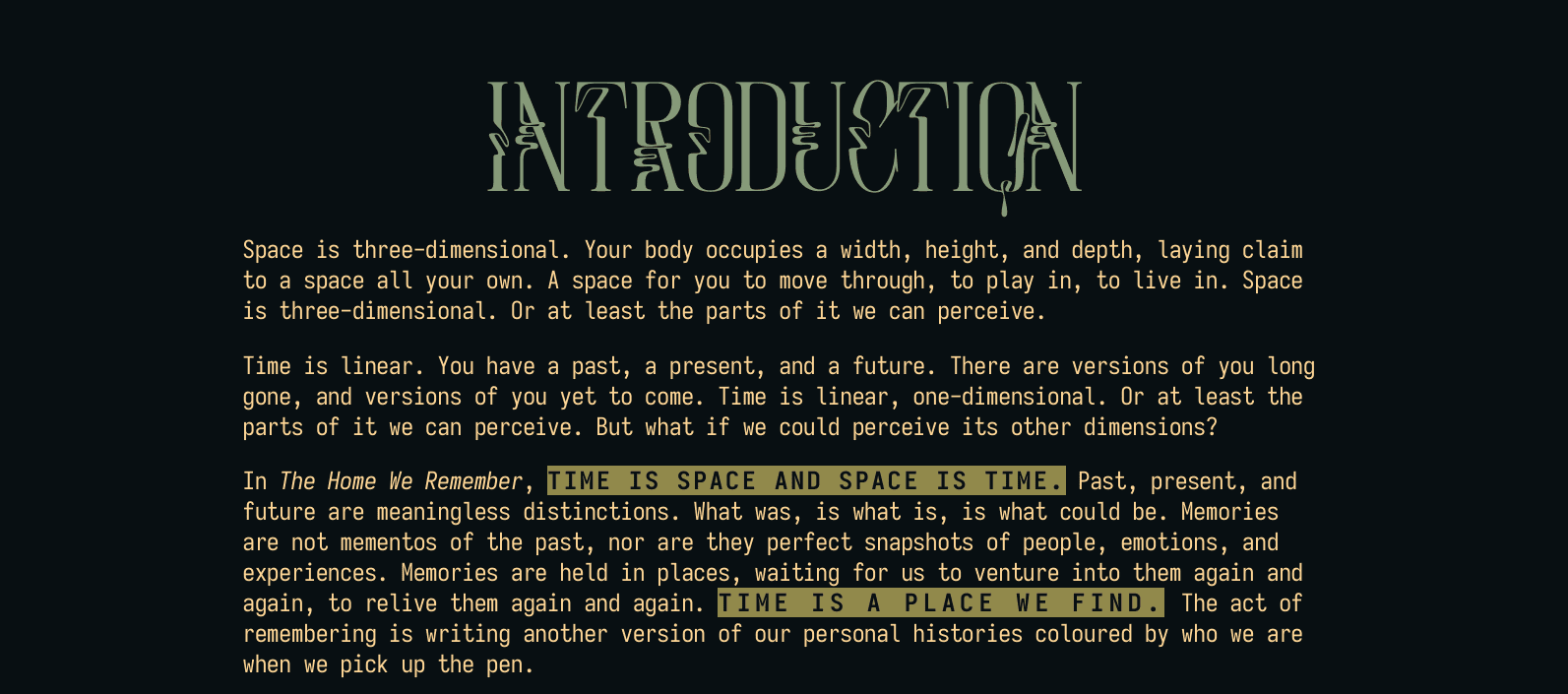
One of the players takes on the role of an architect, embodying the game’s cities, houses, and NPCs, as the player characters play to discover each version of themselves and who they become, for better or for worse. Create characters by creating tethers, symbols, and metaphors for the PCs. Decide on the flora and fauna, items, scents, sounds, and time of day (morning, noon, sunrise, clock-out time), and finally draw the ANCHOR tarot card. Anchors asks you to reflect on the meaning and symbolism of tarot cards, what it’s all about, what it could be, and what you’re struggling with. At this point, the game asks you to look in the mirror and ask yourself four questions. who are you? What are your strengths and how are they weaknesses? What is your weakness and how is it a strength? What is hidden, unfinished, or broken beyond repair in your life? The final question gets to the heart of your character’s non-linear story arc in the game. Next, create relationships with other PCs, NPCs with all the complexity they deserve, and three core memories. After this, the game begins with the final tragedy. I haven’t had time to act out my own tragedy yet, but I hope to do so soon.
My biggest criticism is the house we remember There are two elements to this. The first is the layout, and the second is related to the Ashkan nature of the game. The layout is beautiful, it has a strong visual language, and it knows what it wants to say and how to say it. It’s not easy to read. Some rows have one column that takes up most of the page, and in rare cases, two columns can take up most of the page. Some pages include beautiful portraits to break up these paragraphs, but for the most part, this game can feel like a very long read, even though it’s ultimately a refreshing game. This book forces you to sit and think about what you’ve read (which is a good thing), but for me it felt like Sisyphus pushing a rock and trying to get through this great game to the end. Including art in specific locations can help break up pages and make them easier to read. Secondly, the fact that actual play is the main way to learn how to play the house we remember I see that as holding this game back so far. the house we remember Must stand alone outside of actual play for experimental mechanics that may not make it into the final version. If someone has to learn a game using actual play, I tend to see it as an accessibility issue, and that’s especially true for people who don’t have reliable access to the internet. You can also see that there are issues with groups not being able to agree on how the game should be run from a mechanical standpoint. Personally, I believe that actual play should not be the first line of learning a game, but should be secondary or tertiary. Supportive, but not mentoring. Actual play should not be the top priority when designing a TTRPG. Utilizing real-life play as part of education the house we rememberhow to play and perform a game should not be the primary method of learning a game that exists as a mechanical example of a near-finished work. the house we remember I want to sing and watch it soar.
Ashkan and art works in progress
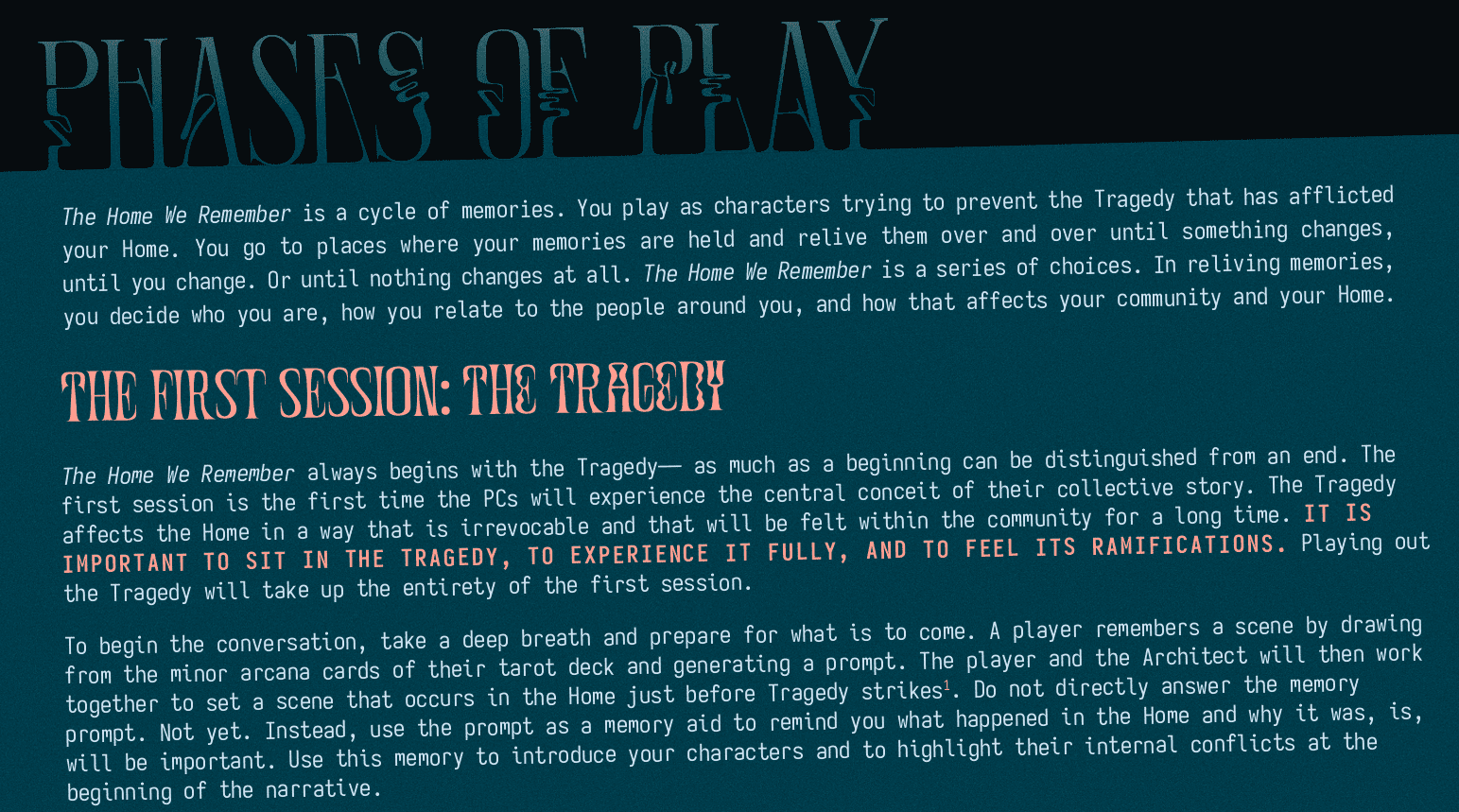
the house we remember As mentioned above, the game is Ashcan, or almost complete enough to be played in a satisfying way, but the entire game has not been released. Ashkan only has 5 Major Arcana cards and 20 Minor Arcana cards with all the prompts written, but full release may take a little longer. This doesn’t detract from my experience reading the game, and actually makes me want to write and explore my own version of “what could have been.” It’s enough to get through a few sessions (my estimate is 3-5 for most groups) and get the ending of a game that hasn’t been fully released yet. To me, this feels pretty appropriate given what this game and its space accomplishes. the house we remember seems like a difficult game to learn and difficult to master, and for some it may be. But I think it adds to the game rather than detracts from it. For me, trying to understand this game was like trying to unravel myself and my relationships. You can’t do that. You have to accept that this game (and you) exists as part of a whole system of other people you’ve never met who knew you existed and made this possible.
About “What if?”
“The act of remembering is writing another version of our personal history, colored by who we were when we picked up the pen.” – Homes We Remember.
“If is the greatest word in the English language.” – my father, his father, and probably his father too.
The human brain is not perfect. You may forget it, overwrite it, or remember it incorrectly. Every time you try to recall a memory, something small, subtle, and seemingly unimportant changes. As this progresses, the entire memory is changed little by little in detail until it is no longer the original memory. This also applies to human beings as they are. When we look back at ourselves and what we have done, we are no longer those people. I hope we have grown and changed for the better. Sometimes it’s not, but we’ve changed nonetheless. the house we remember It asks us to look at what could be, what might happen, what has happened, and what ifs in our lives, and it asks us to reach out and explore it together. the house we remember is a game with a heart that screams, beats, and bleeds at the same time. It’s beautiful, moving, and unforgettable. It is a gentle pain in the heart and memory. i love the house we remember Because it’s trying to create itself. Now go find yourself and all the versions of you.

Do you have strong thoughts about this piece that you need to share? Or maybe you have something else in mind
Fandomentals Want to talk to your friends? Visit our community server and join us
conversation!
Source: The Fandomentals – www.thefandomentals.com


