



What makes us human? Is it our intelligence, our self-awareness, our ability to use tools? Or is it our emotions that control us, a part of us that has been with us since our earliest stages of evolution, a part often called the “lizard brain”?
When we turn on the television or scroll through our phones, we see war, hunger, and destruction around the world. I feel like the emotional part is winning. Painter Christina Starr leans into this, asking us to question how logically and intelligently we can leave such pain behind. Was the philosopher Thomas Hobbes right when he said that life is “solitary, poor, mean, brutish, and short”?
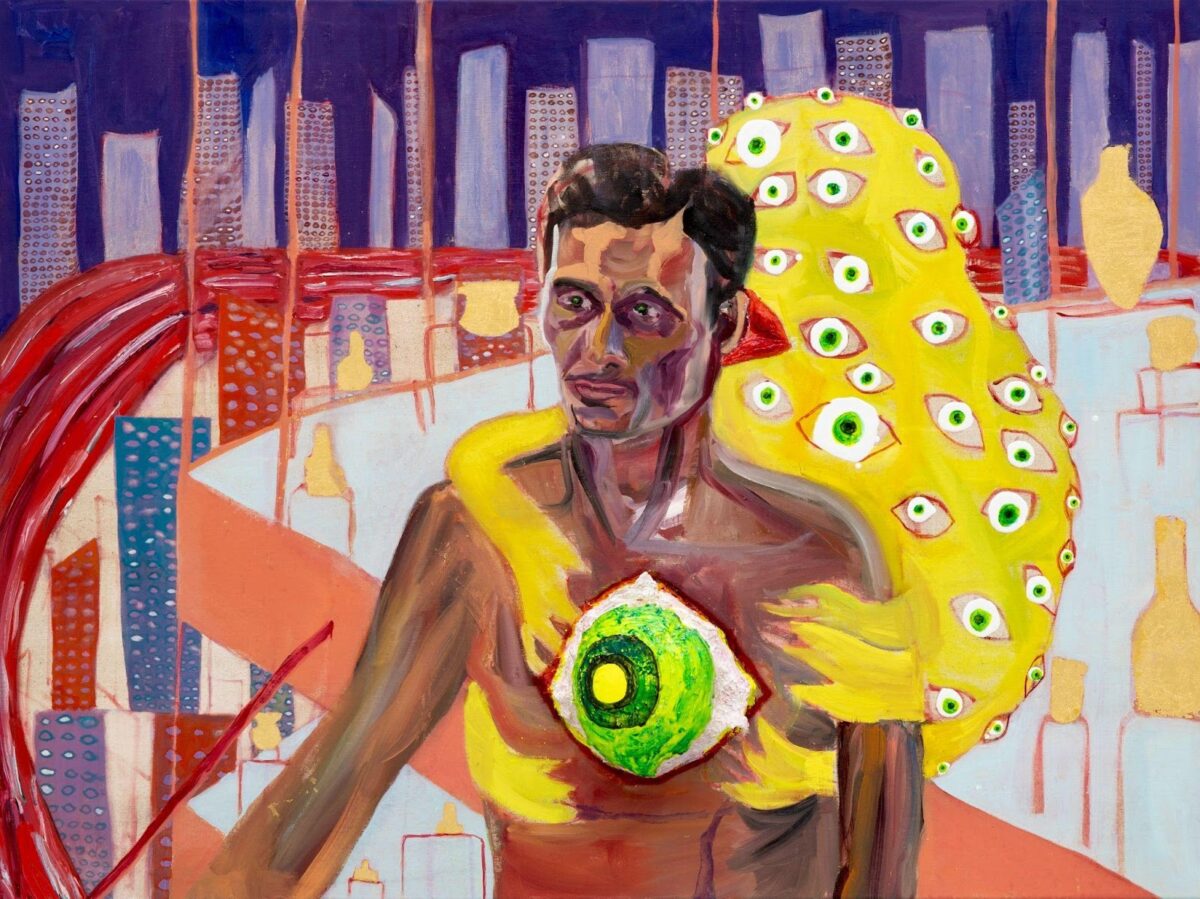
Starr explores both sides of the emotional equation with a violent depiction of a bird giving male genitalia to its offspring and another man tenderly embracing an alien-like figure. Its many eyes bring to mind Jeremy Bentham’s concept of the Panopticon, realized in what Shoshana Zuboff calls the era of surveillance capitalism, where cell phones and cameras track our every move and where customized ads often make us feel as if they know us better than we know ourselves. The question arises: Has technology liberated us or enslaved us?
Two of her most recent works, “Tower” and “Ghost of Boy with Baby Bird,” depict orphaned children as violence occurs around them. This reminds us that in times of war it is often the most vulnerable who suffer, even if their agency is limited or non-existent. We have people to protect them, but when we witness their suffering thousands of miles away, we feel helpless. French philosopher Jean-Paul Sartre once said, “When the rich go to war, it is the poor who die.”
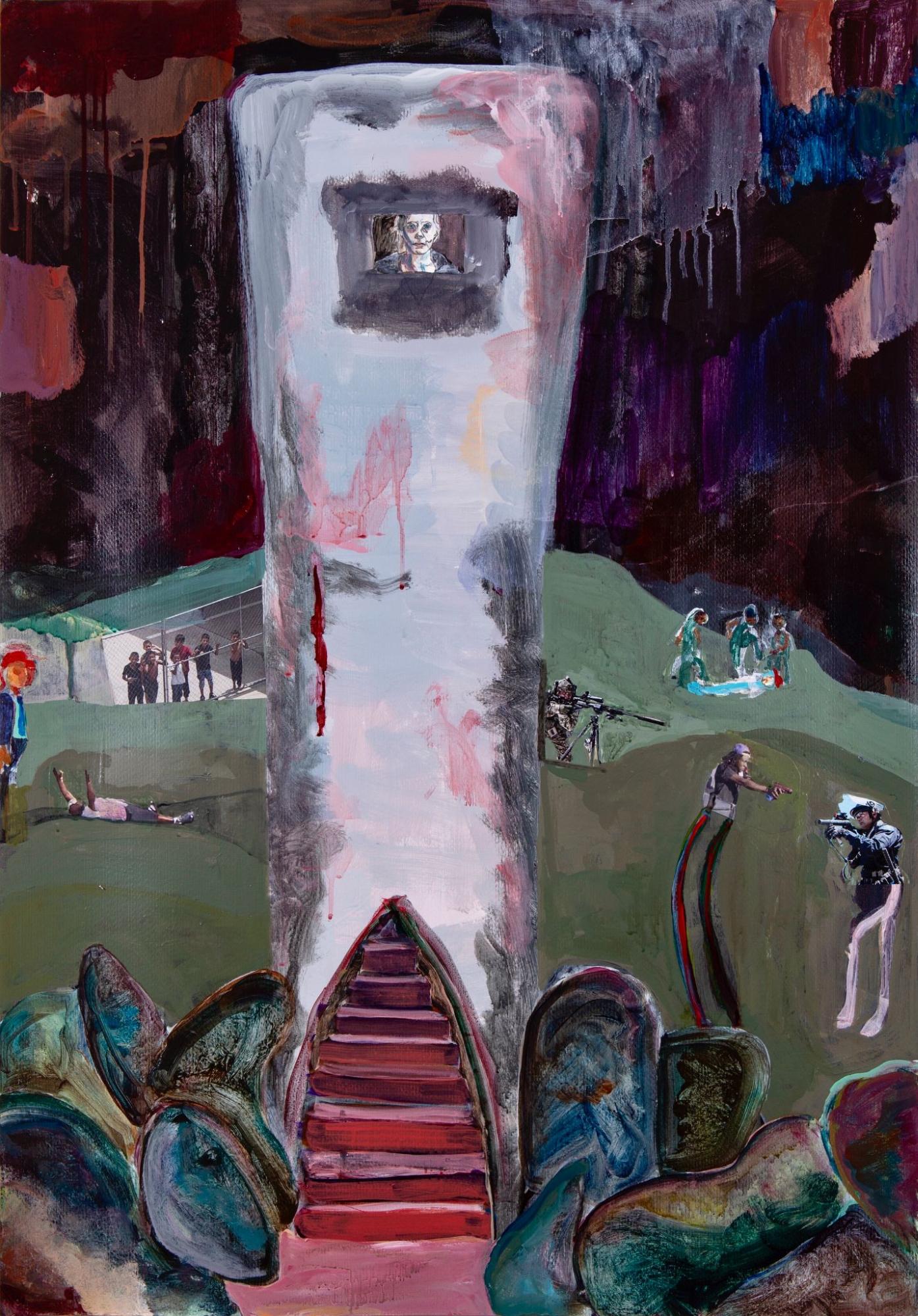
When I think of the child in the tower, I am reminded of Ursula Le Guin’s short story “The Leavers of Omelas”. This novel depicts a utopia where everyone’s happiness depends on the misfortune of one child. As people come to terms with the misery of this child in this story, I often feel that we are in a similar world where, after witnessing the suffering of children around the world, much of the population remains shocked.
The style of the painting recalls Edvard Munch at his most expressive, with a surreal touch found in the works of William Blake. The emotion in each piece is palpable, allowing you to feel the full impact of Starr’s powerful and topical paintings.
Although the works are uncomfortable to look at, it is important to view them while confronting these harsh truths, and both works are on display in a group exhibition EXI 26 held at Crypto Gallery in Londonwill be held from February 4th to 8th. Christina Starr shows us the world we need to know, not the world we want to see.
Learn more about Cristina Starr’s work here. her website and Instagram.
She will have a solo exhibition at the Art and Talking Gallery in Chipping Norton on August 1, 2026.
Source: Our Culture – ourculturemag.com


