



When I look at Mizuki Tanahara’s installations, I feel as if I am scrolling through them and realize that there is an invisible hand controlling the flow of information. These installations do not rely on spectacle. They create moments of awareness, allowing viewers to see familiar technology in unfamiliar ways, and allowing viewers to consider the extent to which their perceptions are being edited by technology before they even see it.
This idea is at the heart of one of her most resonant recent works, “Algorithms/Map of Random Walks.” Tanahara walked through London once, switching every 15 minutes between letting Google Maps dictate the shortest route and letting dice determine the next order. By overlaying these two decision-making modes, she constructed a three-part spatial map. This map reveals how we see cities differently depending on the logics that guide our movements, and how the information we absorb actually moves with them.
In one panel, Tanahara broke down Google Maps’ logic into six categories to show viewers how the system works. This was not done to accuse users of relying on the system, but to provide transparency that many digital systems cannot provide. She then compared Google Maps’ version of London to her own version of London. Her version of the city was created using phrases from her random walks and sensory network maps. The contrast between the two versions of London could not be greater. The London version of Google Maps is orderly, logical, and fully filtered for efficiency. Her version of London is chaotic, visceral, and full of unexpected details that only arose because she didn’t take the path of least resistance. The third part of the installation compared the structures of both routes, creating a visual representation of two very different cities. One is designed with ease of use in mind, and the other evolves as a result of curiosity.
The honesty of the installation creates impact. Tanahara does not claim that the map is dangerous. Instead, she asks questions about the extent to which we allow convenience to become the default way of experiencing the world, and whether we replace curiosity with choices determined by algorithms. This installation is a gentle reminder that wandering, whether physical or mental, is something we are gradually forgetting.
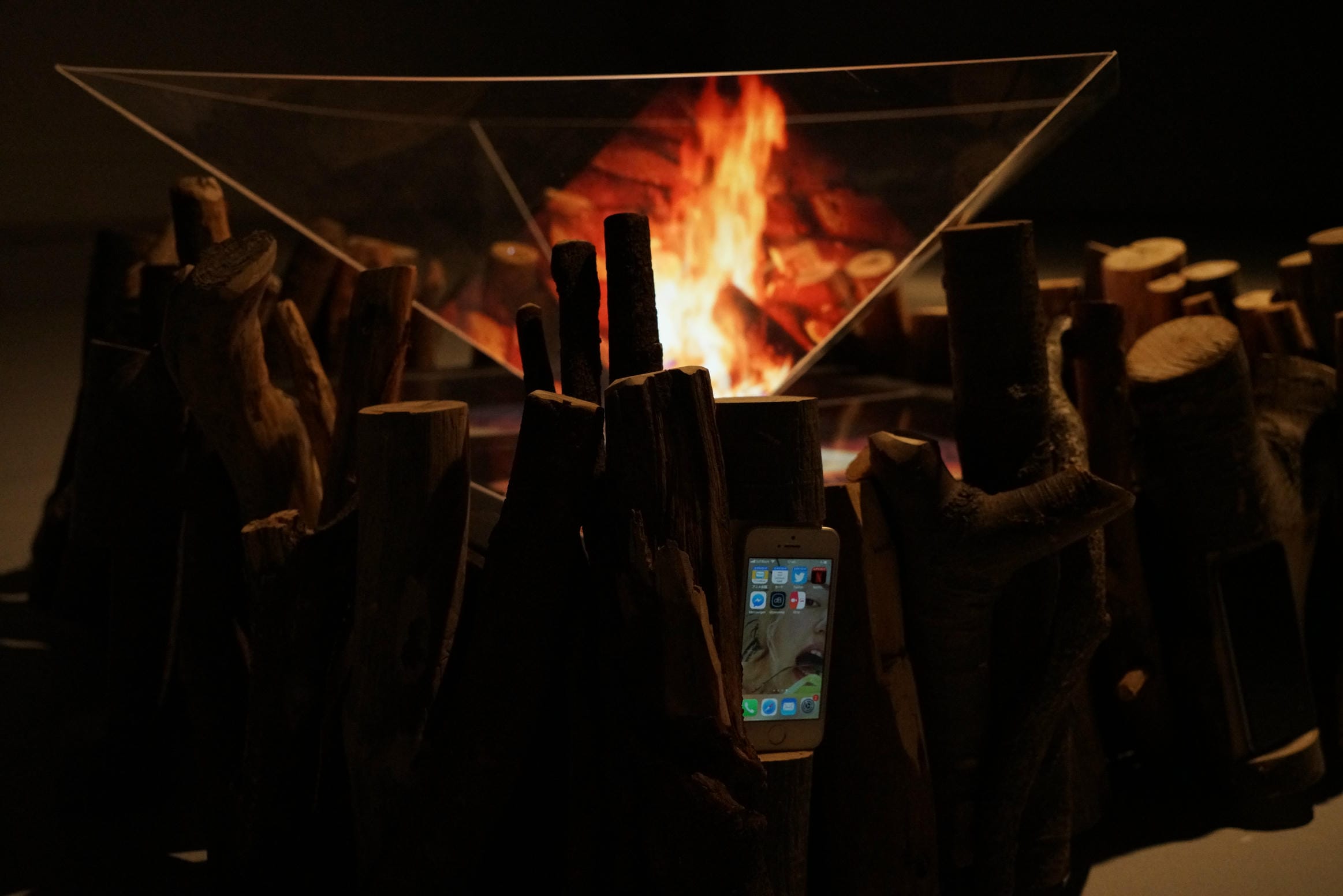
Similarly, the need to regain a sense of realism is evident in Taki-Bi (2018). Takibi is an installation built on the traditional ritual of sitting around a fire and sharing time together. Initially, the installation appears to be a communal object, inviting strangers to sit together without any negotiation. However, Tanahara follows a simple rule. If you want to charge your phone, you need to place your phone on top of the charging device and leave it until charging is complete. That brief, forced pause while standing in a crowded space without a phone becomes the focal point of the installation. Strangers walk around each other uncomfortably but curiously, rediscovering the small social interactions that we usually avoid by locking ourselves away behind our screens.
Takibi draws inspiration from long-standing rhythms of human behavior. People have been sitting around fires for centuries, not just to cook, but to converse, wait, and just be together. Tanahara revives this ancient rhythm in a modern context and uses it to question the comfort of our personal digital bubbles. Taki-Bi does not criticize anyone for their habits, but presents a different perspective, one in which physical presence may take precedence.
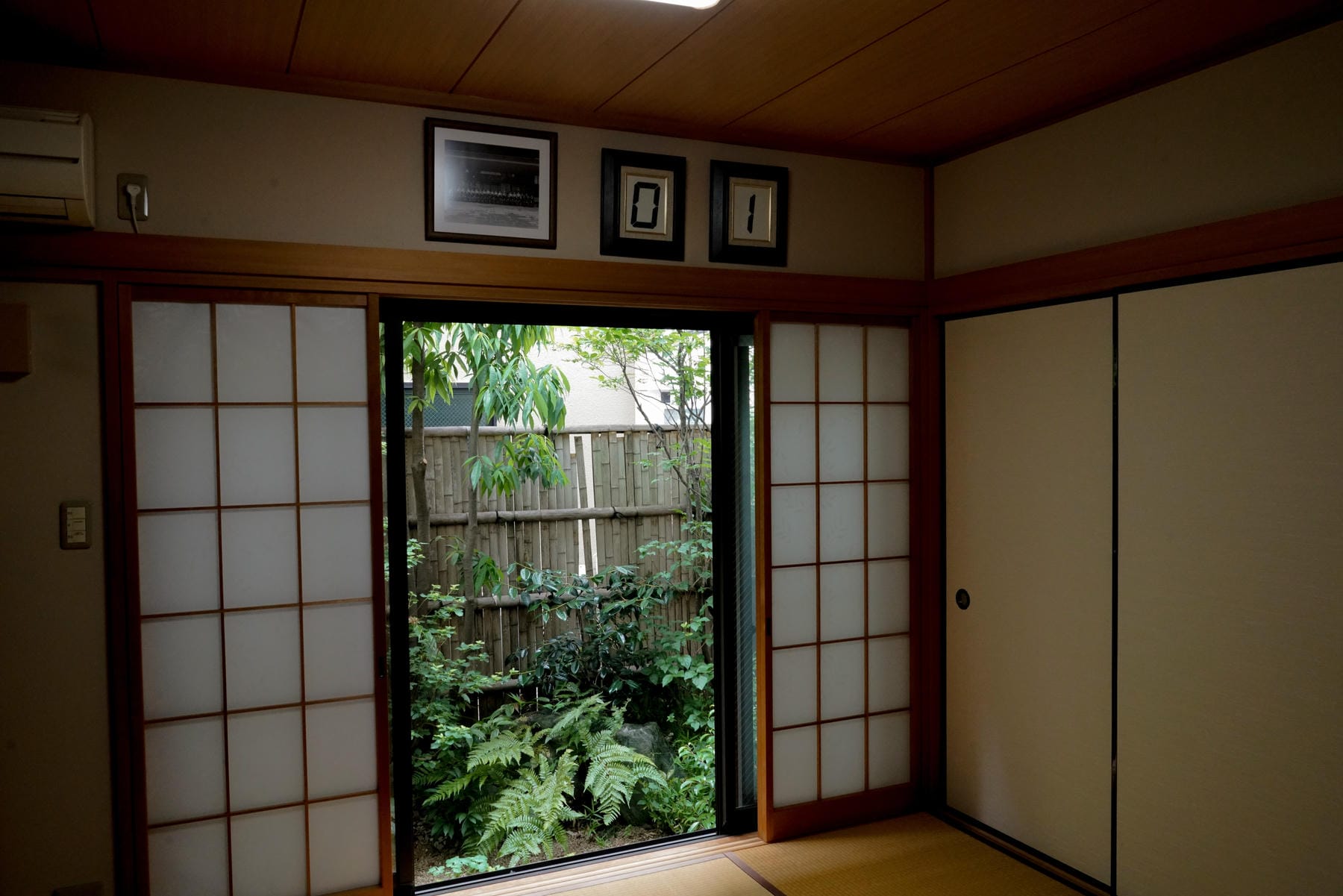
Tanahara’s critique of digital authority becomes more explicit in Big Brother (2020), an installation that explores how numbers have replaced spiritual or political leaders as the primary influence shaping our daily lives. Traditionally in Japan, families hang statues of ancestors or respected figures high up in their homes as symbols of guidance. Tanahara replaces these with the logic of metrics such as ratings, scores, predictive models, and algorithmic values. The resulting installation is uncomfortable, yet familiar. Today, we live in a society where numbers determine value, visibility, opportunity, and even morality. Tanahara reiterates the traditional practice of placing revered objects in high places by explaining how we have quietly placed data in an almost sacred position. The question hanging above the installation is simple, yet daunting. Who governs us in this day and age?
Throughout her work, Tanahara repeatedly returns to the question of how digital systems covertly shape our behavior. Indeed, rather than focusing on the technical mechanics behind specific projects, she uses tools like privacy interfaces, surveys, and playful decision-making systems to reveal how easily we can adapt to the structures set by big platforms. By using digital life not as a set of tools but as an environment that influences identity, agency, and emotional states, her installations encourage people to become aware of the habits they have absorbed and the assumptions they rarely question. Through these participatory experiences, she opens up space for viewers to consider how much of their online behavior is chosen, and exactly how much is inherited from the design of the surrounding systems.
Source: Our Culture – ourculturemag.com


