



Artist: Fan Xinyu, Iris Jingyi Zeng
interval: October 31st – November 3rd, 2025
venue: Safe House 1, 139 Copeland Road, London, SE15 3SN
unnamed, unhollowed, unwritten, uncut This is a two-person exhibition by. Fan Xinyu and Iris Jingyi Zeng Presented at Safehouse 1, London as part of Photo Month London 2025. Inside this fragile Victorian-era building, the two artists construct a temporary sense of ‘home’. Here, home is not something stable or definable or a place to return to. It was born quietly between moves and residences, and melts the moment it takes shape. It circulates silently through the body and memory, leaving subtle but lasting traces. These traces mark generational rifts, unbreakable bonds, and points of self-entrenchment that one tries to hold onto as one navigates life’s changing trajectory. The exhibition title is nameless, hollow, unwritten, not disconnectedreflects the artist’s continued encounter with home amid continuous migration and temporary residence, that is, wandering at the entrance to “home” and touching “home” in wandering awareness.
The exhibition will consist of four interwoven works. Fan Xinyu‘s house and 31 Forming a soft layer of “home” through color images and the warmth of everyday objects, Iris Jingyi Zeng‘s A place where trees remember and under the tree The remains of space, the shadows of time, and the immediate appendages of moving bodies are traced in black and white, negatives, and touches of stitching.
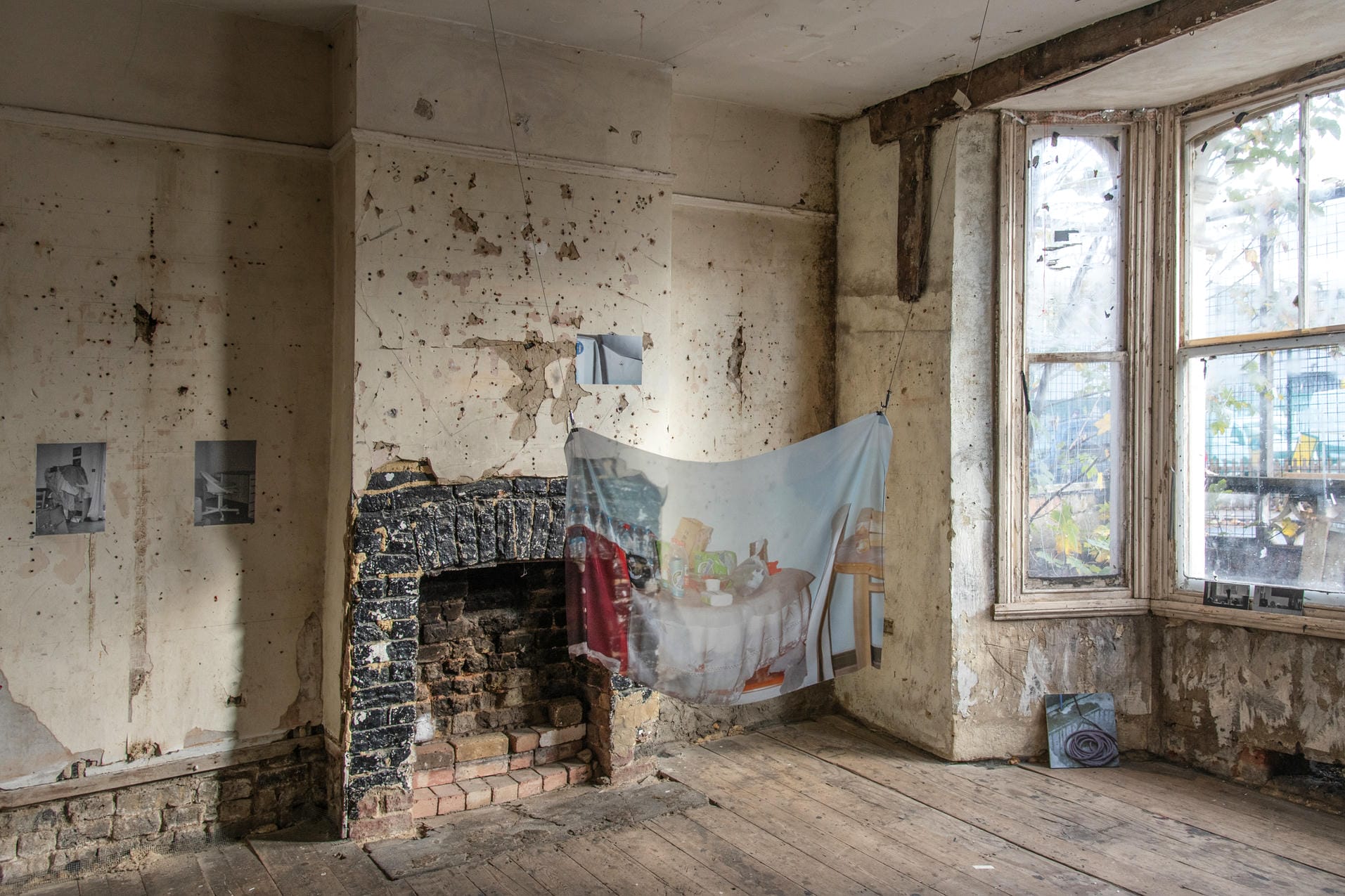
of house The series was filmed in an old house. Shinu‘s paternal and maternal grandparents, where their parents grew up. Although this “home” is not part of her living environment, it forms the background of her life. Although she did not actually live there, she has been shaped by the land through language, family history, and intergenerational memories. She approaches the traces through a tactile perspective, not to understand their meaning, but to understand the distance between herself and these traces. Images printed on fabric are gently pulled downward in space, forming a temporary, soft and unstable structure. Like curtains that are stretched but constantly loosening, the shape of the “house” appears and dims as the air moves. Her sense of this “home” also indicates her relationship with her parents and elders. Although they have been close since birth, they are characterized by a growing gap between generations.
Thirty one “Diary of May 2024” expresses the texture of time in a lighter, more delicate way. Every day of the month Shinu I took the leaves home and arranged them according to the positions on that month’s calendar to make a Polaroid. Each of the 31 leaves traces a quiet arc of withering, forming a calendar that offers an aimless way of gazing aimlessly, simply, unguardedly at the traces of time and life, or rather, gazing upon them and each other. The shift, warmth, grain, and unpredictability of Polaroid film make time itself tangible. The work is not a record that withers away, but a record of the act of seeing it every day. It’s the continuous breathing of silently murmuring “I’m still here” over and over again, and the gentle finding of oneself in the midst of drifting and uncertainty.
A place where trees remember It starts from the moment when the house is gradually emptied. iris begins recording when her first housemate leaves, and she herself leaves the place where she has lived for the longest time since leaving home and begins a new life. The “house” is being dismantled, and at the same time another “home” is beginning to form. The traces of the old and the blank spaces of the new overwrite each other, and the tactile memories of objects like tree roots are rearranged in the act of transplantation. The black-and-white images capture changes in temperature as objects are moved, replaced, or placed anew: the trembling of light on a cup, a dismantled piece of furniture, a plant on a windowsill, a scrape on the floor. These are not recollections of memories, but memories suspended at the border between presence and absence. “Home” here is transitional, but it is by no means hollow. Like a root system that adjusts its direction during movement, it unfolds through the very act of change and reveals the subtle forms of being that emerge in movement.
under the tree I turned my attention to the large tree just outside my balcony. One summer afternoon, when a road sign was being installed under it for construction, Iris noticed the tree and began a patient observation that lasted from summer to winter. Static road signs accompanied the transition from wooded to bare, providing a stable anchor amidst the changing rhythms of passers-by and traffic. The day the last leaf fell, the sign was taken down and winter was here. Falling leaves, changing light, and seasonal cycles are reconstructed into a form of vision that feels close to the body through the softness of the negative and the touch of stitching. Stitching is similar to both mending and holding on, and is a gesture for grasping stable coordinates in our ever-moving lives. The works are soft, thin, and delicately fragile, swaying in the slightest breeze, interweaving color images floating in space with the rhythm of breathing.
What unites the four bodies of work in a common exhibition is not simply their engagement with “home,” but the way in which they collectively reveal how “home” manifests itself in a life marked by continual displacement and shifting ground. “Home” is not a place or a fixed emotional memory, but a perceptual field that is constantly being generated. It is made up of traces of repeated gestures to find oneself, histories inherited but not lived, and forms of intimacy and distance. It arises not only from the surface of everyday life, but also from the unfinished reverberations of memory, at once concrete and empty, remaining yet continually being rewritten.
The parallel upbringings of the two artists and their travels across different cultural contexts further clarify this theme. The rapidly changing landscape of East Asian, especially modern Chinese society, has been shaped by the constant collision of accelerating urbanization and changing conditions, creating distinct generational structures and a uniquely discontinuous texture of lived experience. In this way, “home” appears both intimate and distant, tender yet isolated. Although it seems somehow suspended in the air, it is deeply engraved in our bodies through language, customs, and culture. As they move across cities, countries, cultures, and languages, “home” becomes both a pull and a disconnect in their lives, a point of origin and a direction that continues to take shape.
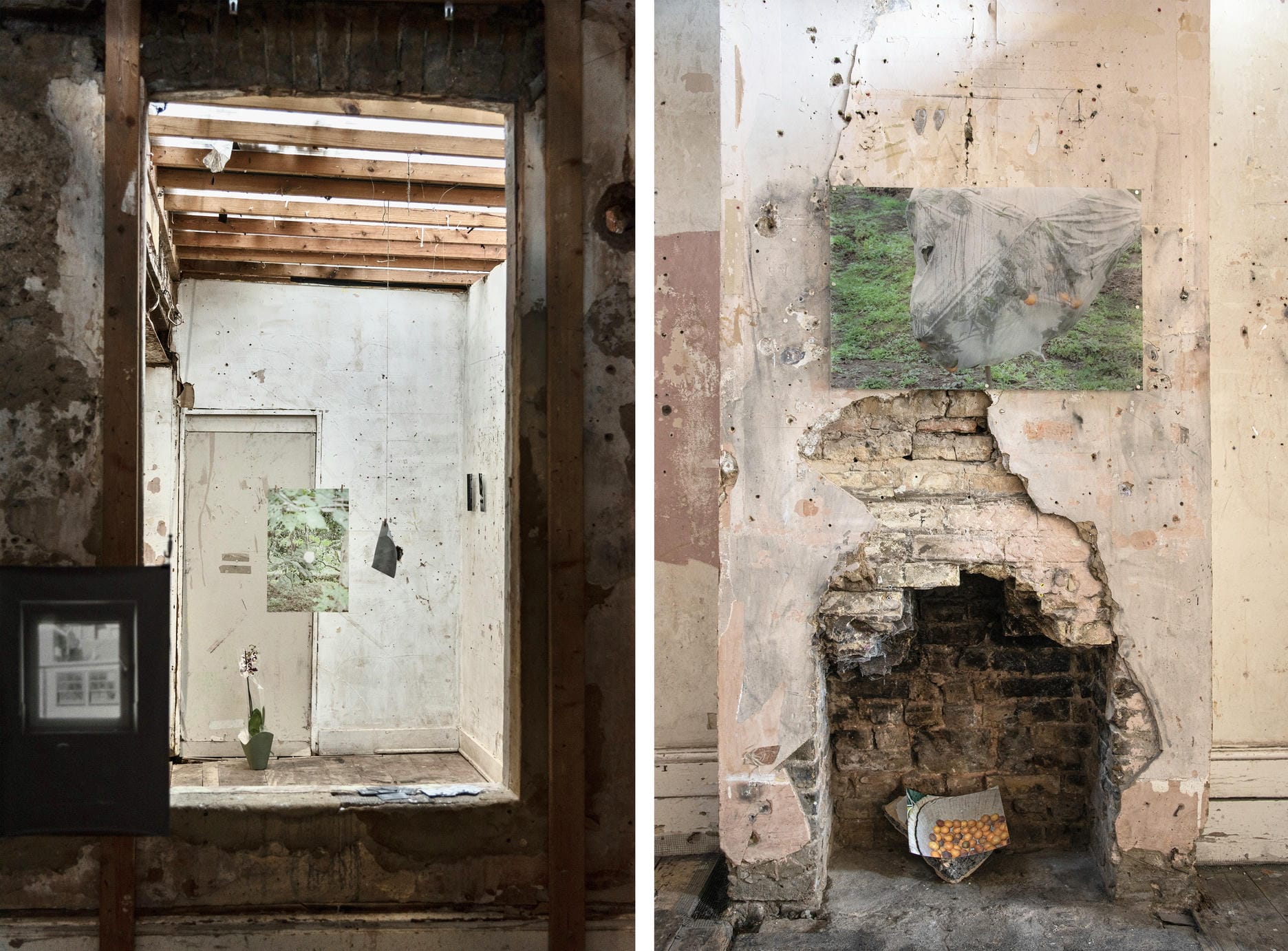
Although the spatial characteristics of Safehouse 1 are not part of the exhibition’s theme, they naturally resonate with the work. Peeling walls, exposed beams, cracks, sealed doors, randomly nailed boards, and the traces of a space constantly in the process of alteration constitute a porous environment within which the works are gently woven, rather than rigidly installed. Image and space slowly approach each other, forming a breathing rhythm between color and monochrome, objects and plants.
The fabric print hangs gently downward in contrast to the stiffness of the beams, creating a temporary, soft, and unstable structure. As the air moves, the shape of the “house” appears and disappears, like a curtain that is raised and then constantly loosened again. Broken bricks and branches sit quietly, the surface of the paper has slight wrinkles from nails that don’t meet, and the sound of cracks echoes throughout the room. The works are housed in a fireplace, clustered around a raw hole in the wall, moving along its crevices and changing lines of sight, allowing image and architecture to meet at the seams where ‘home’ is formed.
On the middle floor, the dark rooms are almost completely cut off from light, with four light boxes as the only light sources, and images appear as instances of light in the darkness, as if the shape of a “house” emerges in a suspended silence.
unnamed, unhollowed, unwritten, uncut It’s not about answering what “home” is, it’s about showing how it feels, touches, and is created. It presents “home” as something caught between disconnection and connection, stability and instability, as memory and trace, as something that is interrupted but never disappears. It is a quiet and intimate attempt to construct a personal history through fragments, gestures and ruins. “Home” here is not a place to return to, but a state that continues to be felt between movement and stoppage, a “home” that simply exists quietly there, without a name, without a void, without being written down or divided.
Source: Our Culture – ourculturemag.com


