



Imagine you are walking through a museum. As you explore, interactive pins appear, each a gateway to discovery. Tap a pin and you’ll be transported to an immersive space where history comes to life through a scavenger hunt game, revealing the stories and secrets behind each artifact. This is the experience Nuoran Chen and his team brought to life in a virtual New York Times Museum product demo video. This project reimagines the hidden gem that is the New York Times Museum, tucked away on the 15th floor of the NYT office building and accessible only to employees who work there. Chen and his team’s vision is to open this space to the world and showcase more than 170 years of journalism history through innovative virtual experiences. This concept design won top honors at the 2025 International Design Excellence Awards (IDEA). The person behind this project is main designer Nuoran Chen, whose work is shaped by a long-standing interest in inclusive design.
Nuoran Chen grew up in an era where information was more readily available than ever before. But he argues that this richness has made designers complacent and assume that everyone has easy access, ignoring those who still face barriers. His passion is bridging this gap – making services and information more accessible to people with limited abilities. For the past three years, I’ve worked as a product designer at major media companies such as The New York Times and The Washington Post, working to embed inclusive thinking throughout the design process from concept to commercialization. His personal project further strengthens his efforts by inviting users into the decision-making process. These principles are realized through three projects that reveal different aspects of his approach to inclusive design.
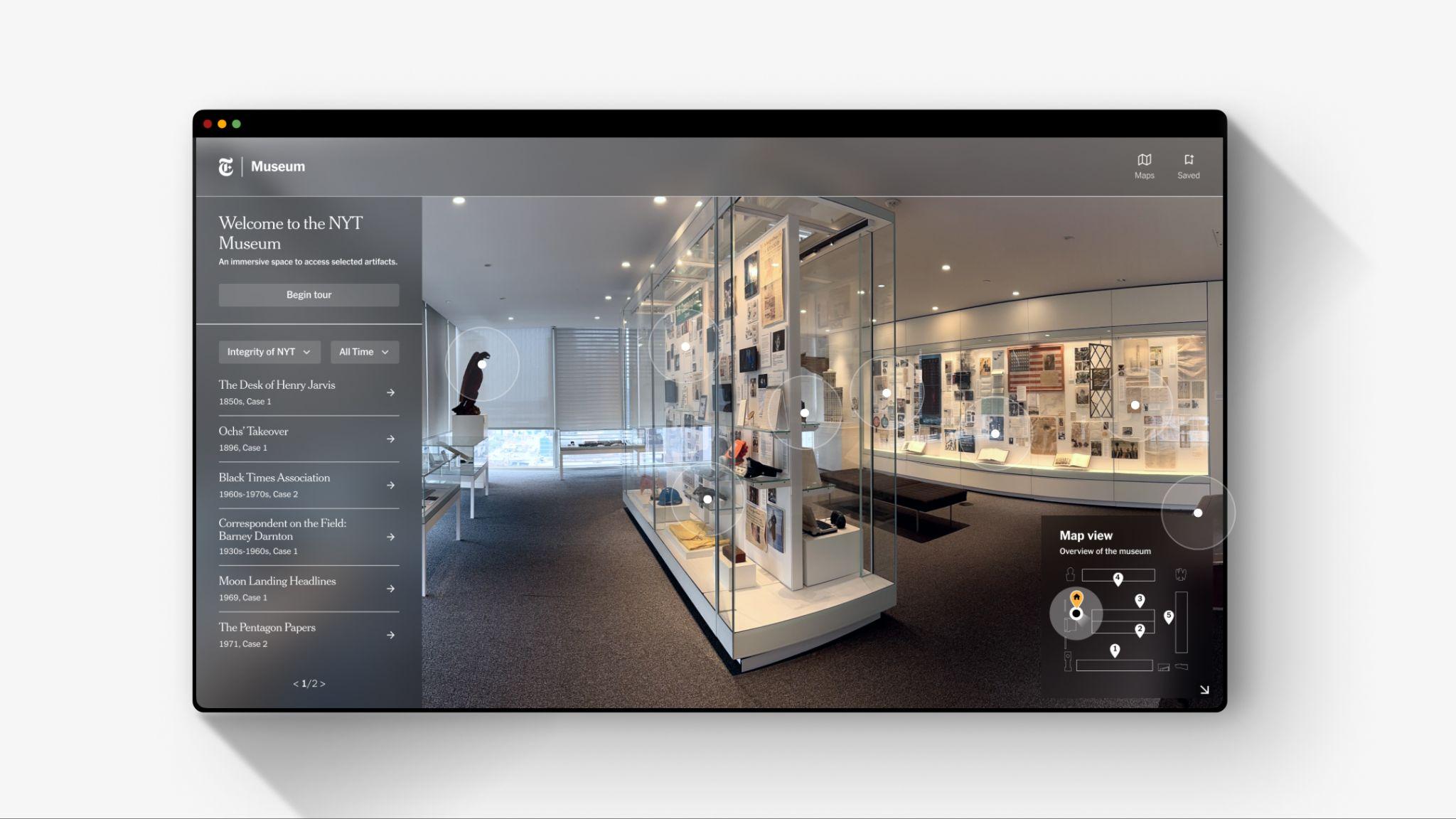
The Virtual New York Times Museum project embodies Chen’s commitment to making exclusive physical spaces digitally accessible while maintaining physical authenticity. In his role on this project, Chen focused on transforming the museum’s solemn in-person experience into a digital experience through a unified design language that guides users throughout their journey. He didn’t just create another online gallery where users scroll through a grid of images. Instead, we used photogrammetry to capture the physical space itself, creating a digital twin that preserves the museum’s atmosphere and spatial relationships. We also designed a spatial UI system that supports the entire experience, from museum navigation to treasure hunt interactions. Interactive pins anchor artifacts in real-world locations within the digital twin and appear naturally as users explore the space. This recreates the feeling of actually strolling through a museum, providing a serious yet engaging experience. The UI is intentionally restrained, fading into the environment and foregrounding journalism while providing subtle cues to guide exploration and interaction. Each artifact includes an audio description, extending the experience to viewers who prefer or rely on audio. Through this project, Chen demonstrates how design can remove barriers to physical access while preserving the authenticity of the original experience and deepening engagement.
Chen’s comprehensive design efforts also extend to the system level, enhancing the accessibility of all products. Chen’s work at the Washington Post to internationalize its content management system exemplifies this idea. He helped the company reach more clients who use Arabic and Hebrew by improving the accessibility of its design system and through right-to-left (RTL) language adoption guidance. Chen emphasized that implementing RTL goes beyond simply mirroring components onto a screen, and requires a thorough design of information hierarchies, interaction gestures, and iconography within a specific cultural context. He created the first component-level documentation of RTL for the Washington Post ArcXP design system. It includes all these nuances that help different teams build with intent, ensuring consistency across the platform. For Chen, this research proved that improving accessibility at the design system level can produce win-win results. “For businesses, teams can build products faster and generate more revenue streams while reducing legal risk. For users, it makes products easier to use and more accessible.”
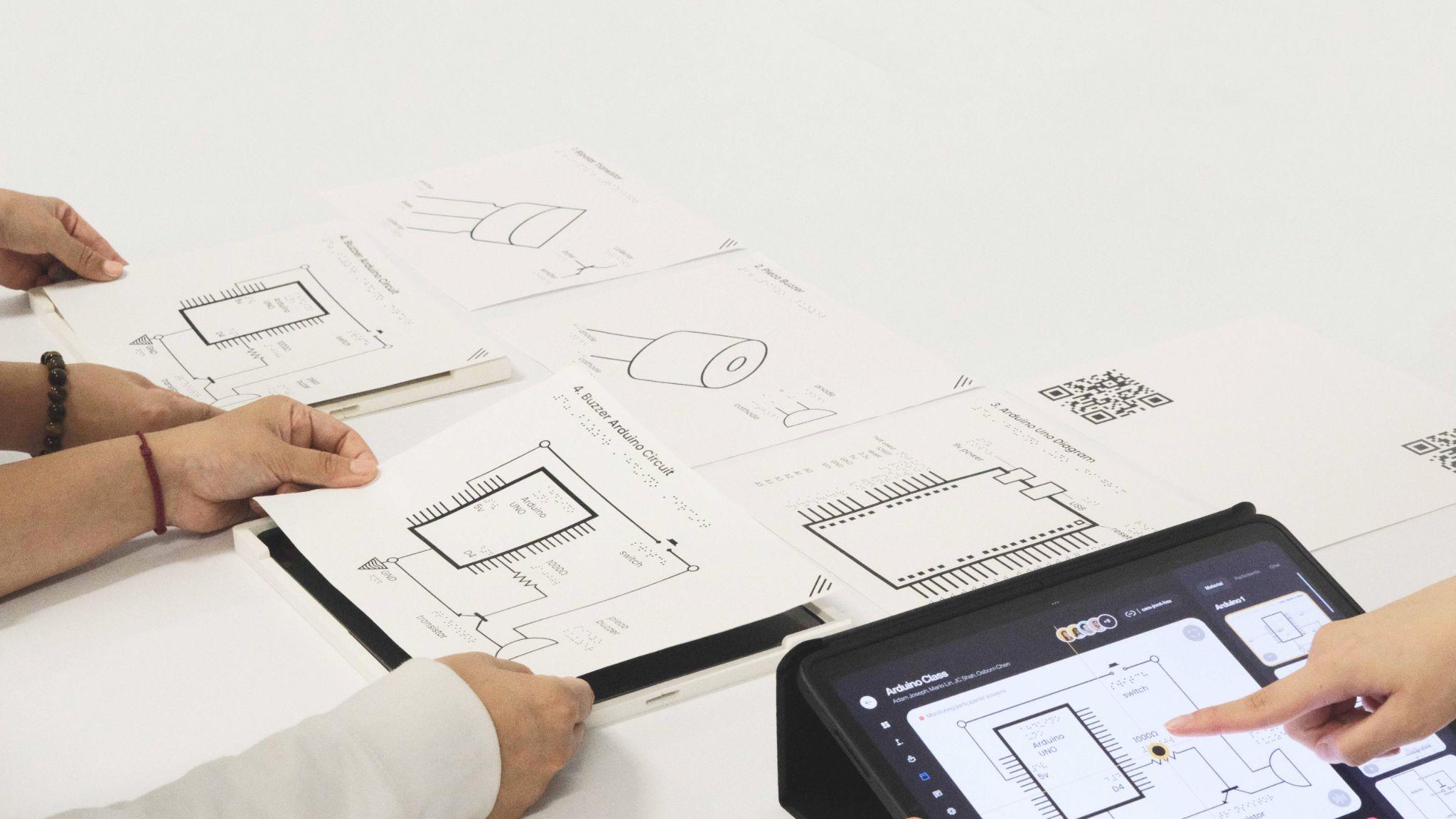
Chen’s personal project, TactileLink, incorporates his holistic design approach into the design process itself. This challenges the traditional design process of creating a solution first and consulting users later. When Chen and his team volunteered for a blind Arduino class at the East Bay Center for the Visually Impaired, they observed the instructor physically guiding each student’s hand one-on-one on a tactile diagram. This approach made it difficult to teach multiple students. Rather than designing a solution individually, Cheng involved visually impaired students and instructors in the process from the beginning. Together they brainstormed ideas, built prototypes, and tested their solutions in a real classroom environment. The result is TactileLink, a tactile graphics education system that makes tactile graphics education more accessible in class or remotely. One instructor can now teach multiple visually impaired students at the same time. Students can easily find elements with audio feedback. As you move your finger over the diagram on the tablet, the pitch changes. The pitch increases near the target element and decreases as it moves away.
Taken together, Chen’s work reflects a consistent approach to comprehensive design that transcends individual artifacts. While often working within large collaborative teams, he has been responsible for shaping both how products are built and how their impact is understood, whether it’s defining interaction models that preserve the physical context of digital spaces, establishing system-level standards to guide future teams, or reframing accessibility efforts to be seen as innovation rather than adaptation. In both organizational projects and independent efforts, Chen demonstrates that inclusive design is not a fixed set of techniques, but a strategic practice that requires advocacy, cross-disciplinary coordination, and long-term thinking. His work highlights how designers can expand access and achieve massive reach, even within complex organizations where accessibility was not originally a priority.
Source: Our Culture – ourculturemag.com


